
Editor’s note: In Part 1 of our series on Portland, Oregon’s vibrant fiber community, you met shepherd Audrey Comerford of Wee Woollies Fiber Arts, a small sheep farm and wool business.
Join Emily Lymm as she introduces us to two more inspiring fiber artists with a strong focus on sustainability in Part 2 of our series on Portland’s thriving natural-fiber community!
Vibrant Valley Farm
Owner: Kara Gilbert
Location: Sauvie Island, Oregon
 Kara says this image reflects “where the end of the season meets a busy farmer celebrating fall with friends. Always a little disheveled, always very proud.” Photo by Jeralyn Fix
“Farming is so littered with identity, place, and ego.”
It’s not the answer you expect when you ask about indigo production, but it offers an immediate glimpse into how Kara Gilbert thinks about her work. Thoughtful, candid, and refreshingly honest, she approaches farming with both ambition and heart.
Since founding Vibrant Valley Farm on Sauvie Island in 2013, Kara has built a thriving operation known throughout the natural-dye community for its large-scale indigo cultivation. Alongside indigo, she grows flowers and garlic while creating opportunities for people to connect with the land through classes and events on the farm.
What emerges in conversation with Kara is a commitment not only to growing exceptional crops, but to cultivating joy and community. Whether welcoming visitors to the farm, empowering her crew, or sharing the beauty of the natural world, she has created a place where connection is just as important as production.
Click to enlarge:
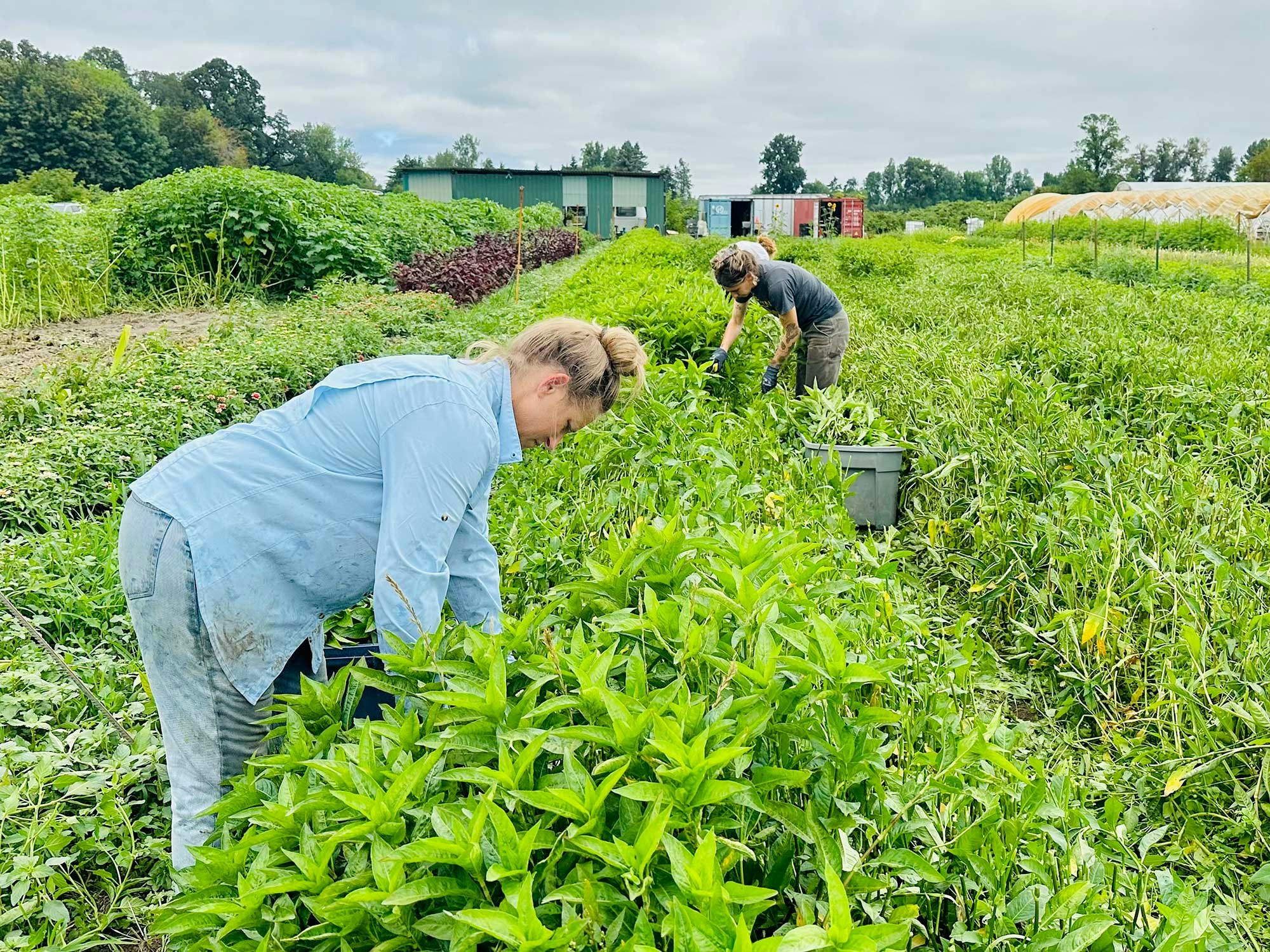
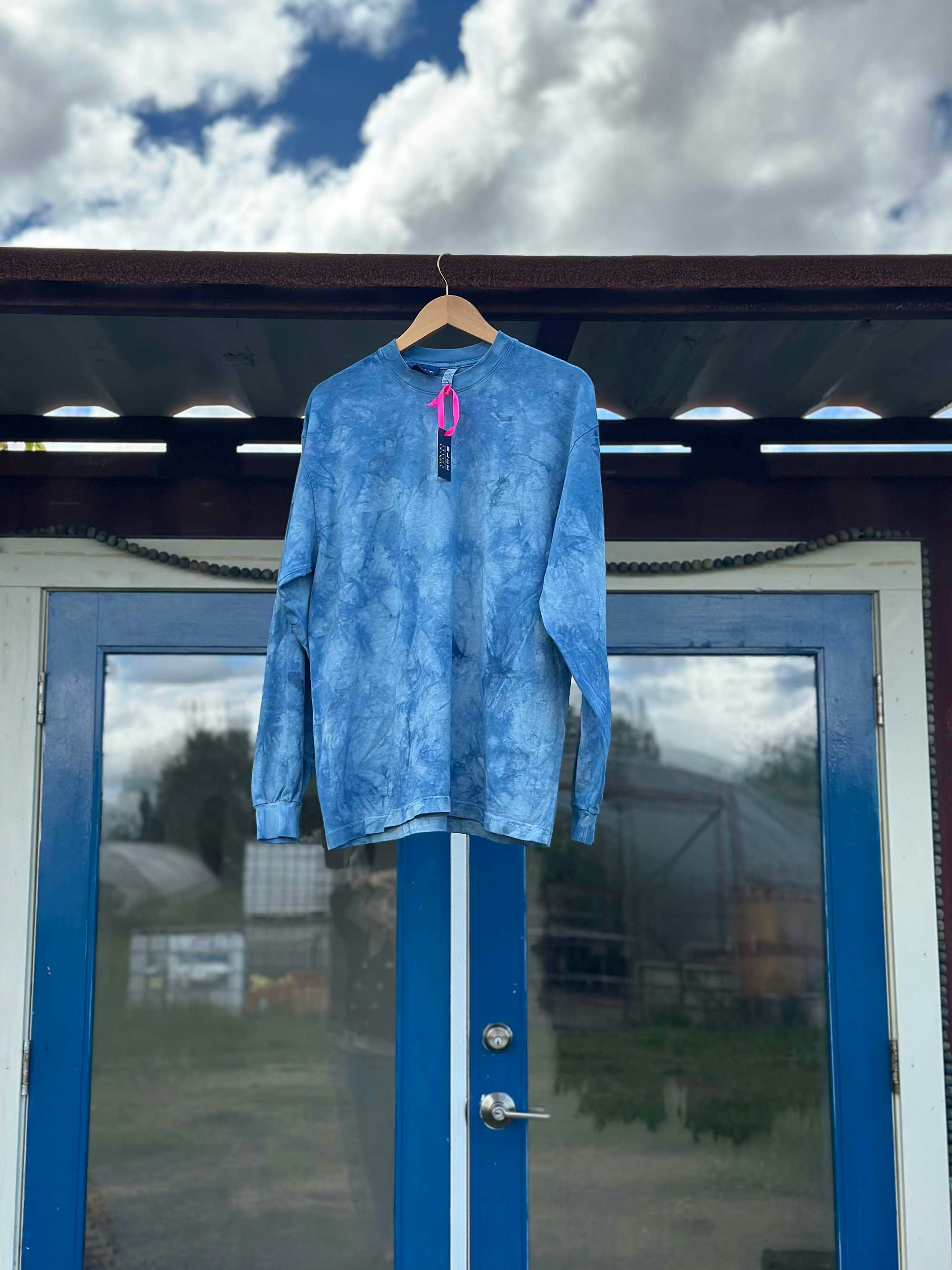
Harvesting the Japanese Indigo (Persicaria Tinctoria) at Vibrant Valley Farm, which started as a crop of 600 plants in 2017. Now the farm harvests up to 10,000 plants per season. Photo at left by Mary Ellen Rice; at right, by Kara Gilbert
Many people know your farm for growing indigo at scale, especially through your work supplying for Botanical Colors. How do you think about that part of your identity, and is there something about your work that feels less visible, but just as important?
Great question! Farming is so littered with identity, place, and ego. Not in a bad way—but due to the intimacy of the work, it’s what it is.
I do feel that producing at scale is part of our identity because it truly exemplifies our eagerness and rigor in raising the bar and finding our lane in the natural-dye world.
Something less viable but equally important is the community we have cultivated around it. Our crew, our ethos, and long-term goals of building a business that elevates the world of flowers, dyes, and garlic production are all as important. Our crew and our care for one another are the foundation for all of these goals to thrive.
 A late-spring bounty from Kara’s farm. Photo courtesy of Vibrant Valley Farm
Your operation has grown significantly since 2013, with a focus on garlic, flowers, and natural dyes. What shaped the focus you have today?
Okay, this is rough and kind of sucks to admit . . . but money. After having two littles, I had to really evaluate what makes capital and what doesn’t. I wholeheartedly believe that growing food is the revolution, but we had to reshape our world to meet my family’s needs, and so it evolved.
And after 2020, our food community really shifted, and there wasn’t the stable bond that had once been there.
 Planting garlic, which Kara describes as “Our favorite day of the year!” Photo by Jeralyn Fix
Education and community are a meaningful part of your work; how do those pieces fit into your broader vision for the farm?
Sharing the farm through events and classes is why we do this. It’s a safe place for people to be and experience nature, and my role as a facilitator to share the depths of the natural world and artistic expression brings me the utmost joy and admiration. I love creating space and sharing our world. It feels easy, beautiful, and so rewarding.
As the farm has grown, what has made it possible for you to sustain that momentum, especially through the most physically and logistically demanding seasons?
Our staff has always had an incredible retention rate, so systems have a place to evolve and grow with less training, etc. In turn, I have had time to give up power and empower others to lead and build our business.
And my husband is an incredible piece of our puzzle. He is an electrician by trade, but is our welder, mechanic, and machine specialist. It gives me time to dream and leaves room for deep goal setting and logistical mind-melting!
Learn more about Vibrant Valley Farm on their website at vibrantvalleyfarm.com or on Instagram @vibrantvalleyfarm.
Sea Change Fiber Arts
Owner: Sarah Pedersen
Location: Milwaukie, Oregon
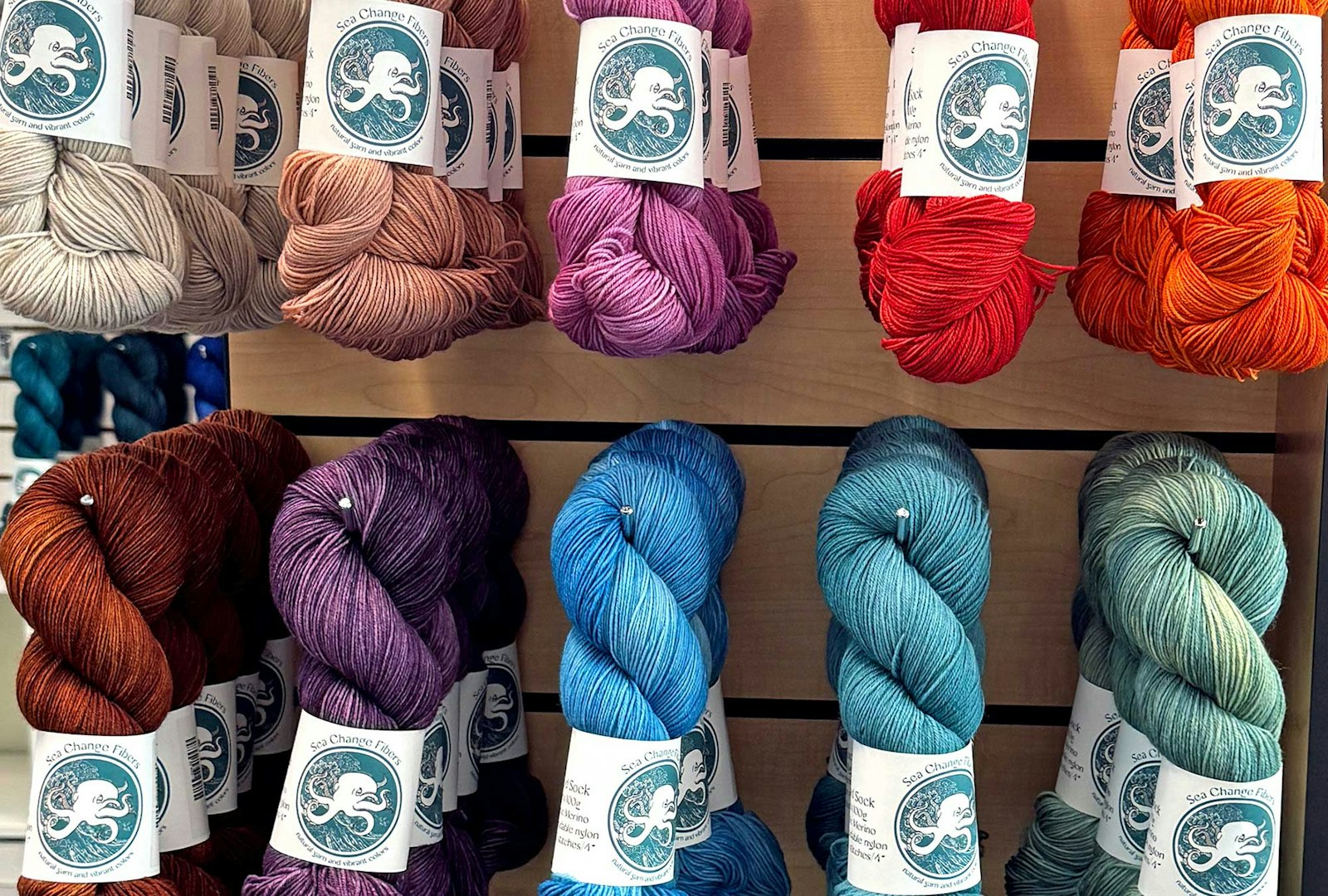
 Sarah stocks the yarn in her new store, now open in Milwaukie, Oregon. Photos courtesy of Sea Change Fibers
Beautiful yarn doesn't happen by accident.
Behind every skein at Sea Change Fiber Arts is a long series of thoughtful choices. Owner Sarah Pedersen carefully reuses water in her dye process, harnesses solar energy to power her studio, and continually looks for ways to lessen her environmental impact. The result is a collection of richly saturated colorways inspired by the forests, beaches, and landscapes of the Pacific Northwest.
But spend a little time getting to know Sarah and it becomes clear that her work is about more than yarn. This year, she opened a yarn shop in downtown Milwaukie, Oregon. Part retail space, part gathering place, it reflects the way she approaches her business: thoughtfully, generously, and with an eye toward building community.
For Sarah, sustainability isn't a marketing strategy. It's a daily practice rooted in the belief that small actions matter. And when repeated over time, those actions can create meaningful change.
You put tremendous effort into working sustainably. Can you describe your water-conservation system for dyeing yarn?
I try to get as much use as possible out of every batch of water. I start with the palest colors and gradually work toward deeper shades within the same color family, which allows me to dye up to six batches in a single pot before changing the water. I also collect water from my dehumidifier for soaking yarn, and because my dye baths are fully exhausted, rinsing takes very little additional water.
 A peek inside Sarah’s dye studio, where she uses as little water as possible.
I understand you also power your dye house with solar energy that you harness yourself. How does that affect your dyeing process?
I usually schedule dyeing days when it’s sunny so the process can run on power generated by my solar panels, with extra energy fed back into the grid. That happens less often in winter, but I also have a solar battery and enough accumulated energy credits on my electric account to help cover the colder months.
You are about to open your first retail shop in downtown Milwaukie, Oregon. Can you tell us about your vision for the store?
The shop is open! It is in downtown Milwaukie and is largely stocked with my yarn. The colors are featured in 18 of my bases, and 4 more will be added in the fall as well. I am also featuring another indie dyer as a pop-up each month, which is currently Kacey Knits. And I’m doing other weekend trunk shows. There is a social gathering space that is always available, and on Thursday nights, the shop is open until 8 pm for social gatherings. Our classes will begin in late June.
 A close-up of Sarah’s vibrant organic yarn that‘s dyed using solar energy and low water consumption.
If you could help improve something about the world through your own practice, what would that be?
The most important thing to me about improving the world is valuing nature. The more we focus on using solar- and wind-powered electricity, recycling water, and being so careful about pollution, the more we will keep the earth, other animals, and humans going for a much longer time. This is why I prioritize the electrical system I use.
Follow Sea Change Fibers on Instagram @seachangefibers or on their website at seachangefibers.com.