
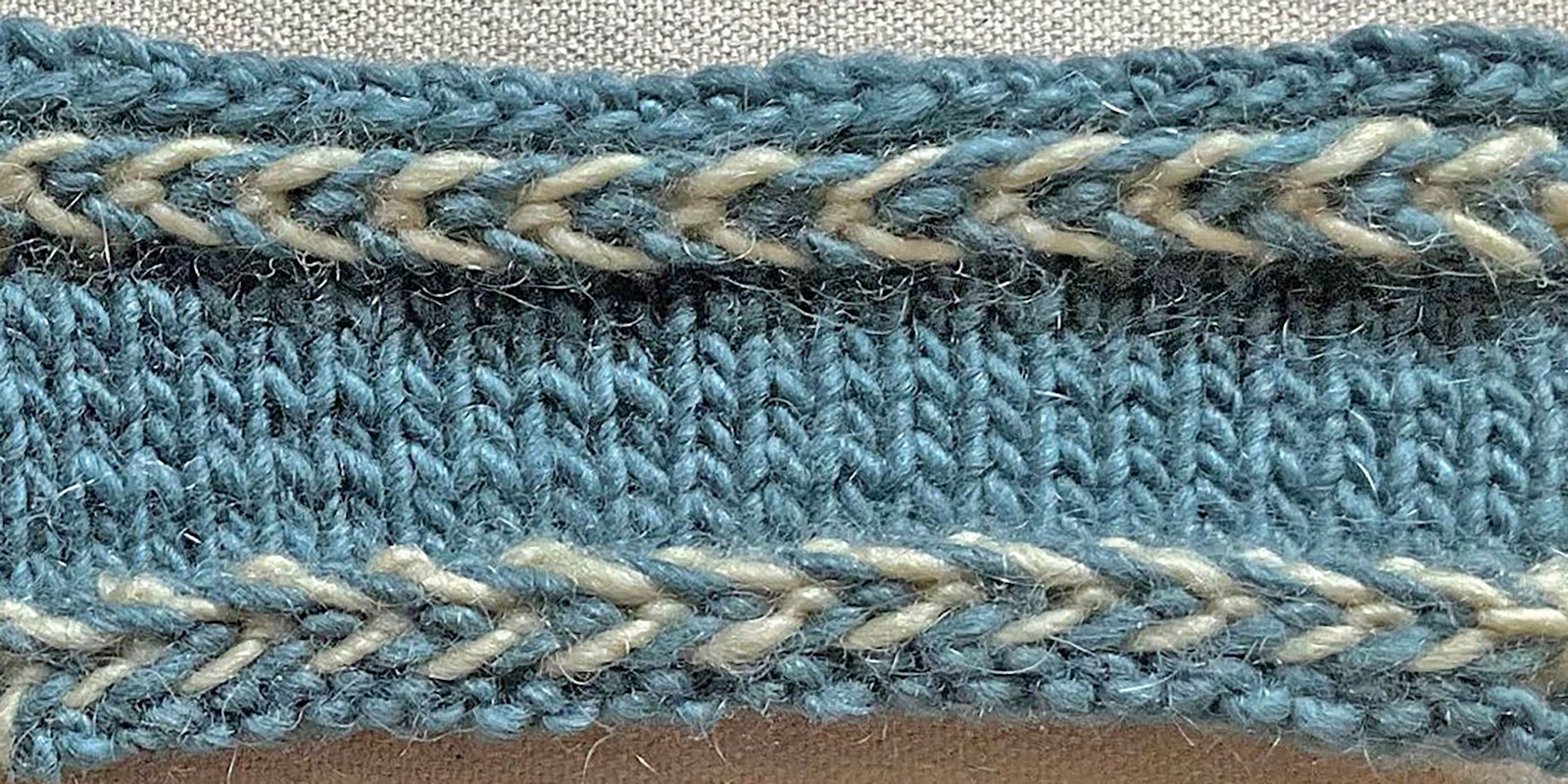
Editor’s note: Latvian braids add a decorative raised ridge that can be placed at the cuff of a pair of mittens or the trim of a knitted hat. Latvian braids can also be used as a colorful design detail on an accessory or the body of a garment. Typically worked with two contrasting colors of wool, the braid is created over three rounds by purling stitches while intentionally crossing the yarn strands. The deliberate twisting—and later untwisting—of the yarns is what produces the pattern on the right side of the fabric.
The world of knitting is amazing in its variety of techniques. Sometimes I feel like I need six or seven lifetimes to try them all. The technique featured here is known as Latvian braid. Though a single color can be used, the Latvian braid is most often worked in two colors of yarn to create a braid that runs perpendicular to your knitting, resulting in a twist or rope accent.
 This traditional Child’s Gansey Sweater, by Beth Brown-Reinsel, is knitted in traditional Guernsey wool. The Latvian braid is used as a decorative element across the body and sleeves. Photo by Joe Coca
The Latvian braid can be worked flat right after the cast-on to create a beautiful edge on a bonnet or worked in the round on mitts or mittens. It can also be used as a design element in the body of a piece, as seen in Beth Brown-Reinsel’s Child’s Gansey Sweater shown above. Don’t get too concerned about your yarns getting twisted together as you work Latvian braid—this is part of the magic!
Let’s learn how to create this beautiful decorative element.
How To: Latvian Braid Worked Flat
 Lativan braid worked flat.
Cast-on an odd number of sts. This version points this way >>>
Row 1 (RS): *K1 with MC, k1 with CC, rep from * to last st, k1 with MC.
Row 2 (WS): *K1 with MC, bring CC over MC, k1 with CC, bring MC over CC, rep from * to last st, k1 with MC.
Row 3 (RS): *P1 with MC, bring CC over MC, p1 with CC, bring MC over CC, rep from * to last st, p1 with MC.
Opposite direction <<<
Row 1 (RS): *K1 with MC, k1 with CC, rep from * to last st, k1 with MC.
Row 2 (WS): *K1 with MC, bring CC under MC, k1 with CC, bring MC under CC, rep from * to last st, k1 with MC.
Row 3 (RS): *P1 with MC, bring CC under MC, p1 with CC, bring MC under CC, rep from * to last st, p1 with MC.
How To: Latvian Braid Worked in the Round
 Latvian braid worked in the round.
Cast-on an even number of sts. This version points >>>
Rnd 1: *K1 with MC, k1 with CC, rep from * to end of rnd.
Rnd 2: *P1 with MC, bring CC under MC, p1 with CC, bring MC under CC, rep from * to end of rnd.
Rnd 3: *P1 with MC, bring CC over MC, p1 with CC, bring MC over CC, rep from * to end of rnd.
Opposite direction <<<
Rnd 1: *K1 with MC, k1 with CC, rep from * to end of rnd.
Rnd 2: *P1 with MC, bring CC over MC, p1 with CC, bring MC over CC, rep from * to end of rnd.
Rnd 3: *P1 with MC, bring CC under MC, p1 with CC, bring MC under CC, rep from * to end of rnd.
 Barbara Kelly-Landry added a Latvian braid to the cuff of her Ultimate Icelandic Hiking Socks as a decorative element with a practical application. Barbara says ”The braid provides a slight tightening at the top of the sock to aid the ribbing in keeping the sock from slipping down the leg.“ Photo by Matt Graves
Katrina’s Tip
The key to this technique is in the twisting of the yarns. As you work the second round, the yarns twist together, and the third round then untwists them. As the yarns twist, they lay over the top of one another below the line of stitches to create the braid pattern.
The Latvian braid is a small technique with a big visual payoff. Whether you use it to finish an edge or add a decorative band, it’s a simple way to bring color, texture, and a bit of traditional flair to your knitting.
Resources
The pattern for the Child’s Gansey Sweater shown here can be found in Knitting Traditions Winter 2011.
Add the Latvian braid to these socks, mitts, or hat patterns that adjust to any yarn and gauge in the Wanderlust Collection eBook.
 Photos by Matt Graves