
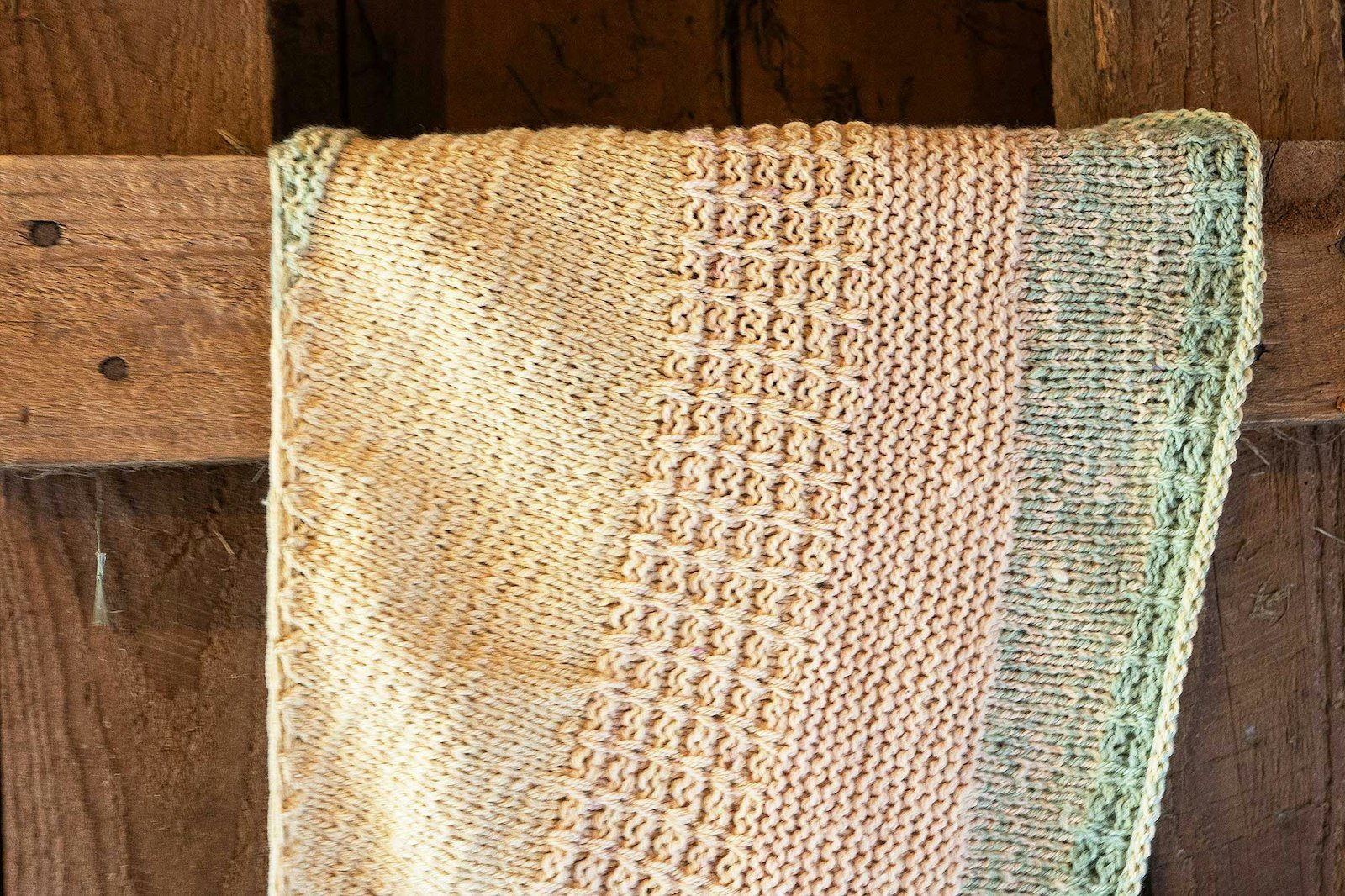
In early spring, when the frost still lingers and the fields glow pale green at sunrise, I often find myself watching the land wake up. There’s a quiet rhythm to it—the slow stretch of light, the first birdsong, the scent of damp earth rising. That rhythm is what I tried to capture as I designed the Field Lines Shawl: comfort rooted in the quiet beauty of everyday life.
Working with small-farm yarns deepens these connections. The wool carries the story of the land it came from, the texture of the soil, the care of the shepherd, the colors born from plants that grow nearby. When I began sketching and designing a shawl inspired by a patchwork of fields, I knew I wanted to use yarn that held the same quiet strength, so I looked to local makers for my materials.
 A young Cormo enjoying lush pasture while growing a beautiful finewool fleece. Photos by Stacy Dresow unless otherwise noted
I first met Stacy Dresow at a local fiber festival, where a table filled with naturally dyed skeins stopped me in my tracks. The colors—soft greens, pale yellows, and gentle peach tones—felt like a spring sunrise captured in wool. When I picked up a skein, the yarn seemed to come alive in my hands; it was so bouncy and buttery soft. It was a Cormo blend from Stacy’s flock at Dresow Family Farm, nestled in the rolling hills of southern Minnesota, just a few hours from my own home in eastern South Dakota.
Stacy and her family raise their sheep with the same care and rhythm that the land teaches: rotational grazing through woodlands and pastures, composting wool and manure to feed the fields, and planting by hand to protect and restore the soil. Every part of the process feels intentional and cyclical, a conversation between shepherd, flock, and landscape. Her yarns are dyed with plants she grows and forages: marigold, goldenrod, walnut, and jewel weed. Each skein holds subtle color shifts that tell the story of a specific place and season.
 Stacy dyes her farm yarns using materials foraged on the farm.
There’s something deeply grounding about working with yarn like this. Each strand carries the slight scent of lanolin from the sheep and the soft hue of foraged blossoms, a tactile reminder of how creativity and nature intertwine. As I began sketching the Field Lines Shawl, I wanted to mirror that same sense of rootedness, the way one color fades gently into another, the way the land folds and rises in quiet rhythm.
 Most of the Dresow flock wear coats that keep fleeces clean as they graze.
The idea for the Field Lines Shawl came to me on a quiet evening drive through the countryside with my husband. It’s something we’ve done for years, ever since high school, when we’d escape town just to follow the back roads and watch the light roll over the fields. There’s a peace in that familiar landscape, the rhythm of fences and fields passing by, the soft glow of color that shifts as the sun begins to set.
 Sections of Shaina’s crescent shawl are knitted one after the next using short rows. Photo by Gale Zucker
The Field Lines Shawl captures that quiet motion through shape and texture. Short rows form gentle, undulating bands that echo rolling fields, while subtle marling between colors mimics the way light drifts across open land. The slip-stitch edging gives structure, like fence lines framing a pasture, and the Icelandic bind-off adds a grounding finish. Its crescent shape makes it an easy, comforting wrap for those early spring days when the air is still crisp, but the light feels new.
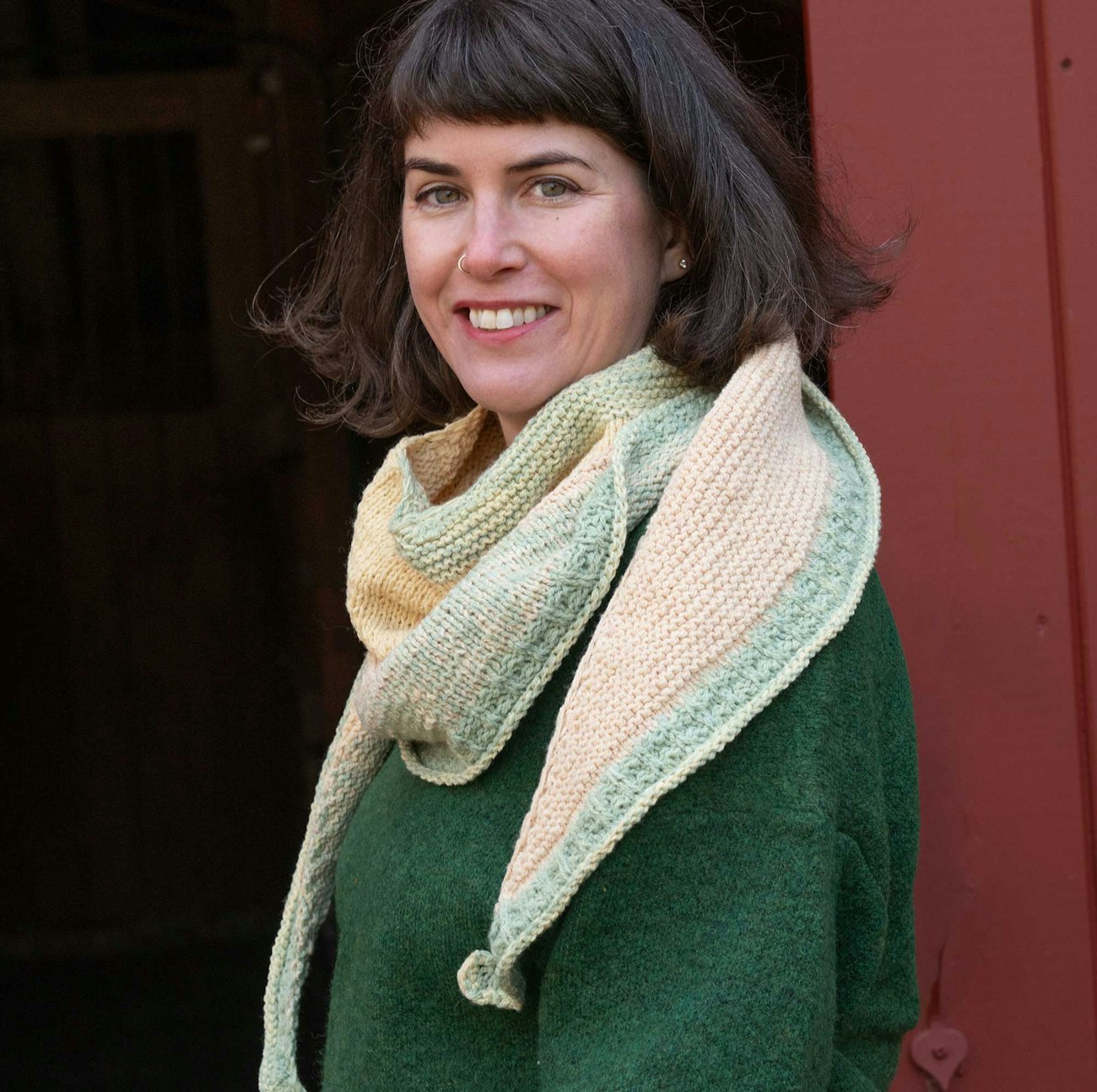
I found that working with Stacy’s Cormo yarn required as much listening as planning. Its airy bounce and soft hand encouraged me to loosen my tension and let the yarn dictate the fabric’s movement. The naturally dyed shades, each one slightly variegated and alive, invited spontaneity as I blended them. I rearranged skeins over and over on my studio table until they felt just right: the soft green giving way to yellow, then peach, like sunlight warming the fields.
Designing with small-farm yarns isn’t just about making something beautiful, it’s a dialogue between memory, material, and place. Each stitch became a way to trace the landscape I love and to hold it close.
Creating the Field Lines Shawl has reminded me that making isn’t separate from the world, it’s part of it. Each skein of yarn carries a story: the care of the farmer, the rhythm of the seasons, the quiet patience of the animals who provide the wool. When we knit, we become part of that story. To me, that’s what it means to be rooted: to make with intention, to honor the land and the hands behind our materials, and to create something that connects us . . . to memory, to place, and to one another.
Subscribers can find the Field Lines Shawl in the Farm & Fiber Knits Library.
And be sure to check out this tutorial on the Icelandic bind-off.