
Editor’s note: Christine wrote to the Farm & Fiber Knits team with a story that’s not about a project or a technique, but about a particularly memorable encounter she had as a volunteer for Project Knitwell. Her story resonated with us because it reflects something we as knitters recognize: knitting is often a catalyst for connection. Yarn in our hands can create healing—for ourselves and others.
Here she shares a quiet lesson in a hospital lobby, one that helps a visitor reconnect with her memories and her family. Learn more about Project Knitwell below.
With fifteen minutes left in my shift—just enough time to teach one more person—I scanned the hospital lobby. The space hummed softly: shoes squeaking on tile, murmured conversations, an overhead announcement dissolving into air. People waited alone and together, hands folded, eyes unfocused.
I approached a woman seated near the windows. She sat upright, handbag at her feet, hands resting loosely in her lap. I introduced myself as a Project Knitwell volunteer and asked if she would like to learn to knit.
“Oh, I used to knit,” she said at once, smiling. “Years ago.” Like so many people in hospitals, she spoke as if the skill had merely gone dormant. Her name was Evelyn. She welcomed the chance to brush up.
As soon as the needles were in her hands, the motion returned. Yarn slid over her fingers; a few tidy stitches appeared. She laughed, surprised by herself.
“May I tell you a story?” she asked.
When her brother was eleven, she said, he came home from school exhilarated. He had learned to knit and couldn’t wait to show his father. Instead, his father flew into a rage. No son of mine will ever take up such a feminine hobby, he shouted. The words struck hard and fast. Her brother never knitted again.
Evelyn watched her hands as she spoke. The needles clicked quietly. The lobby noise receded. She said that the disappointment of that day—so sudden, so complete—had shaped the rest of her brother’s life. She didn’t say whether her father’s anger had ever been turned on her, but a shadow crossed her face, as though she were glancing at something long familiar.
Her brother was in his late sixties now. He wasn’t doing well. She wanted to reach out to him but didn’t know how.
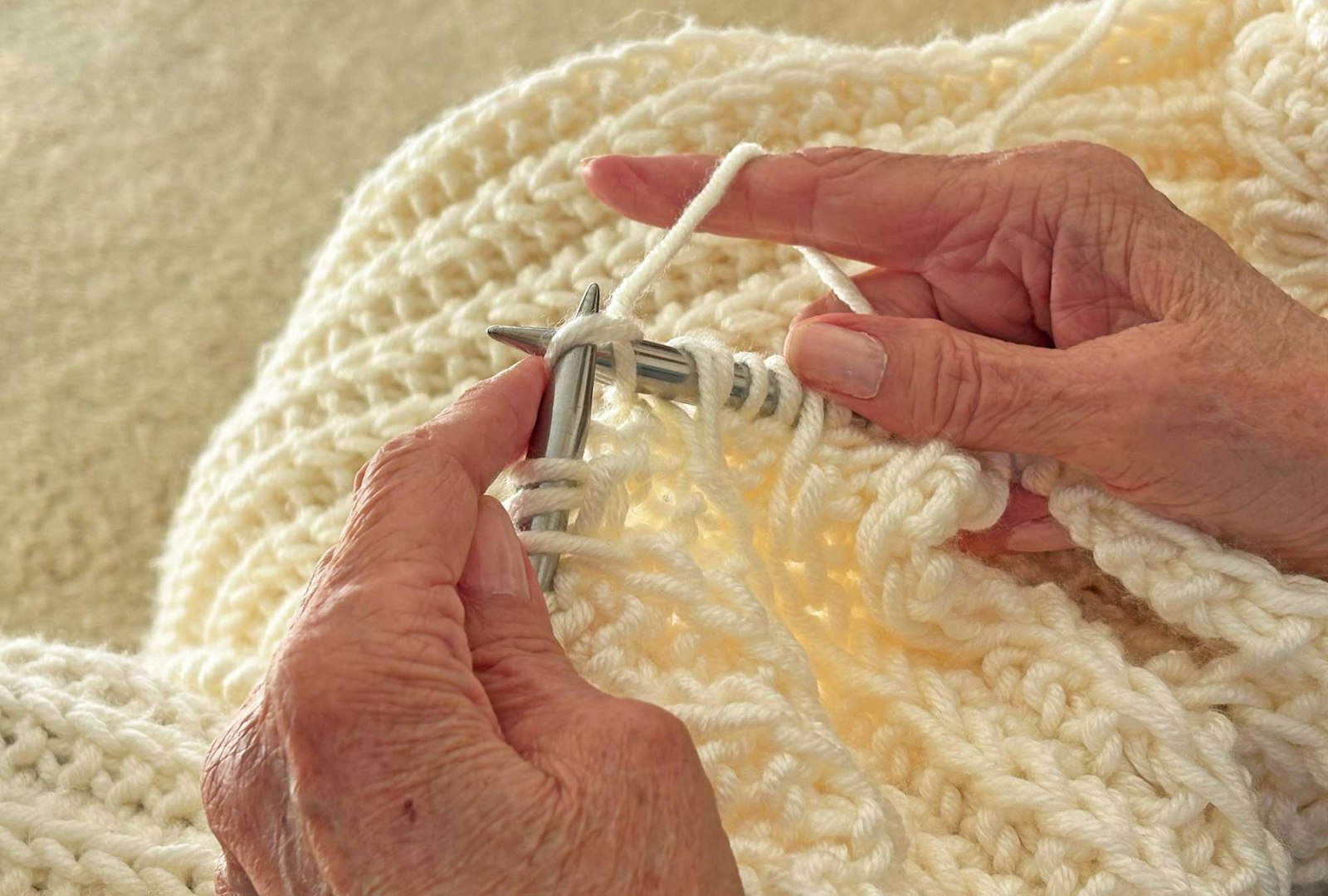
After a moment she asked, “May I take a picture of you knitting? Not your face—just your hands.” She smiled slightly. “I won’t say anything about the past.”
I held the needles while she framed the shot. The yarn looped across my fingers; the fabric hung unfinished, modest. She took a few pictures, chose one, and sent it. The phone slipped back into her bag.
The lesson was over.
Evelyn exhaled, a long breath she seemed not to know she’d been holding. She looked eased—not happy exactly, but lighter. She thanked me, gathered her things, and returned to waiting.
I packed up my needles and moved on, the photograph already on its way.
 Project Knitwell volunteers bring comfort, calm, and community to patients and families—one stitch at a time. Photos courtesy of Project Knitwell
About Project Knitwell:
Project Knitwell helps people facing challenges by providing knitting instruction and shared community opportunities that promote wellness and resilience. All programming is provided by volunteers, and services and supplies are free of charge. Operating in the metro Washington, D.C. area, Project Knitwell is a 501(c)(3) with ongoing programs for patients, family members, and staff at area hospitals, schools, and community sites. Learn more at projectknitwell.org.