Subscriber Exclusive
Knitting in the Round: Which Needle Style is Right for You?
Whether you’re knitting socks, sleeves, or mitten thumbs, the needle style you choose can make all the difference in speed, comfort, and stitch quality.
Whether you’re knitting socks, sleeves, or mitten thumbs, the needle style you choose can make all the difference in speed, comfort, and stitch quality. <a href="https://farmfiberknits.com/knitting-in-the-round-which-needle-style-is-right-for-you/">Continue reading.</a>
https://farmfiberknits.com/cdn-cgi/image/format=auto/https://www.datocms-assets.com/101500/1771518173-needles-for-knitting-in-the-round.jpg?auto=format&w=900
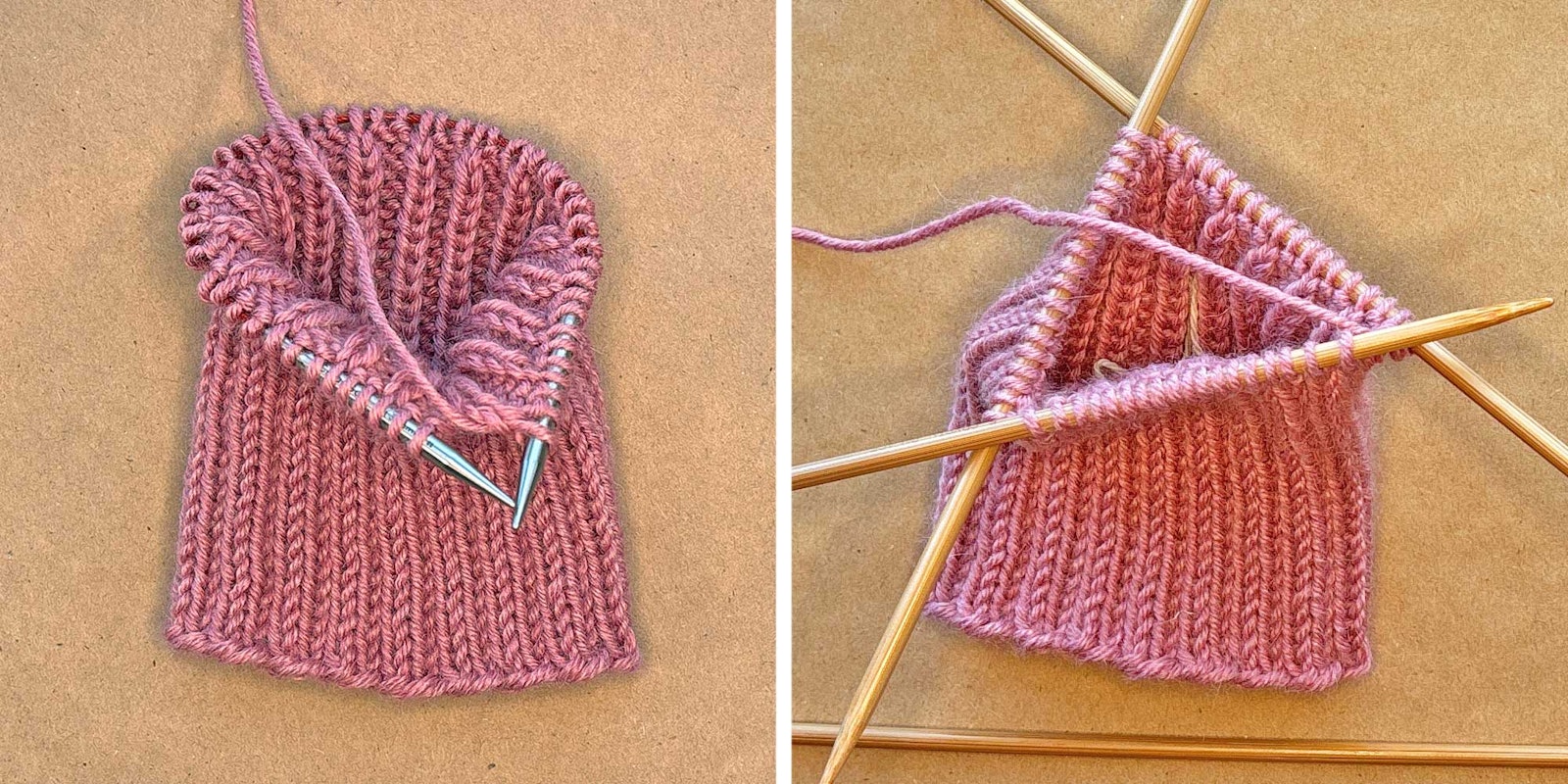
From short circular needles (left), to traditional double-pointed needles (right), to modern hybrids, today’s knitters have more options than ever for tackling small projects in the round. Sandi tackles the pros and cons of five needle options. Photos by Sandi Rosner
If you want to spark a debate in a group of knitters, just ask which needle style is best for knitting small pieces in the round. I can think of five possibilities, and all have fervent devotees. Let’s look at the options and discuss the pros and cons of each.
Double-Pointed Needles
The circular needles we all know and love did not exist before the early twentieth century. Knitting in the round was traditionally done using a set of four or five double-pointed needles. This remains the method of choice for many knitters (including me!).
Get a closer look! Click any image in the gallery below to open it in full-screen mode.
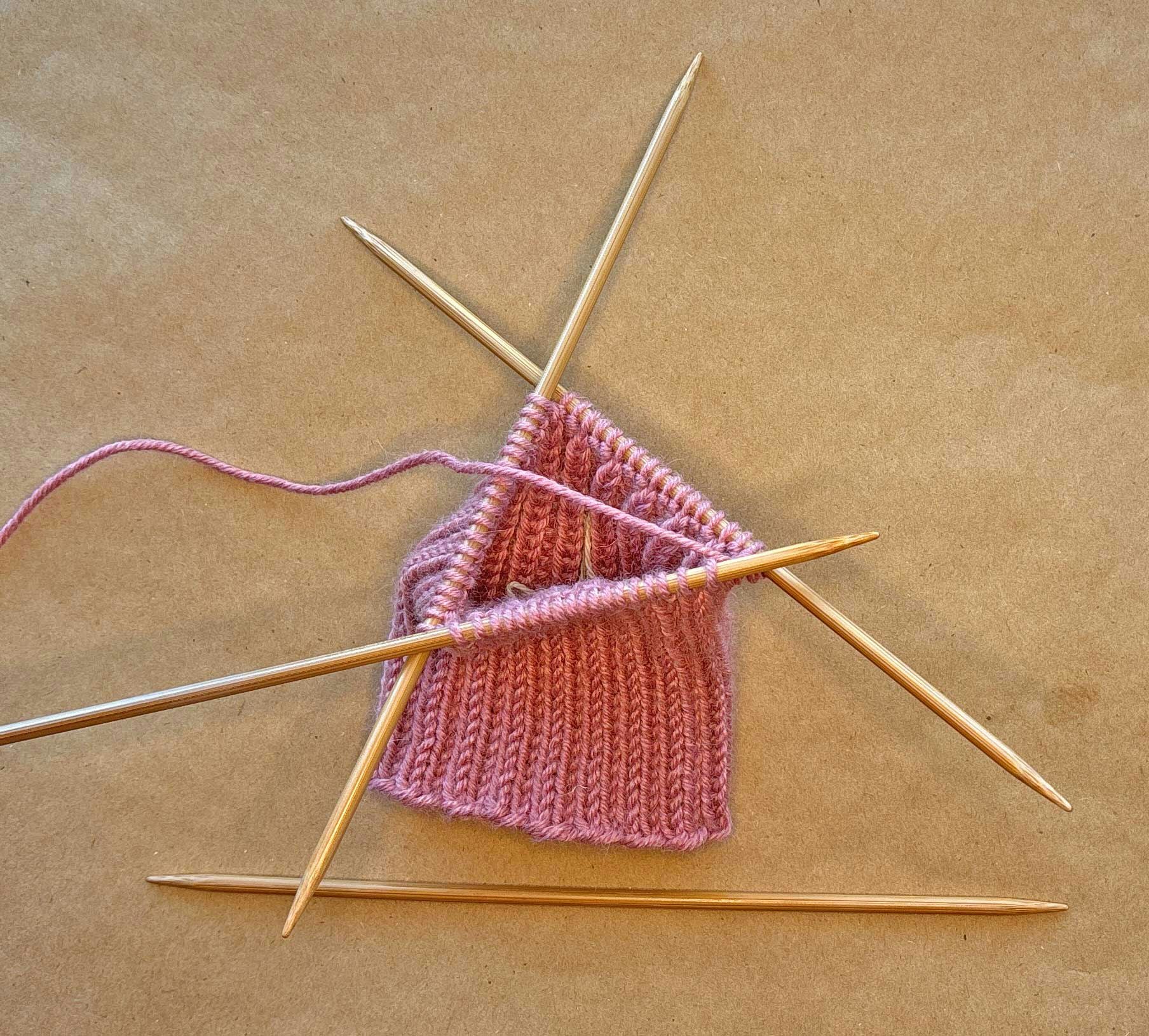
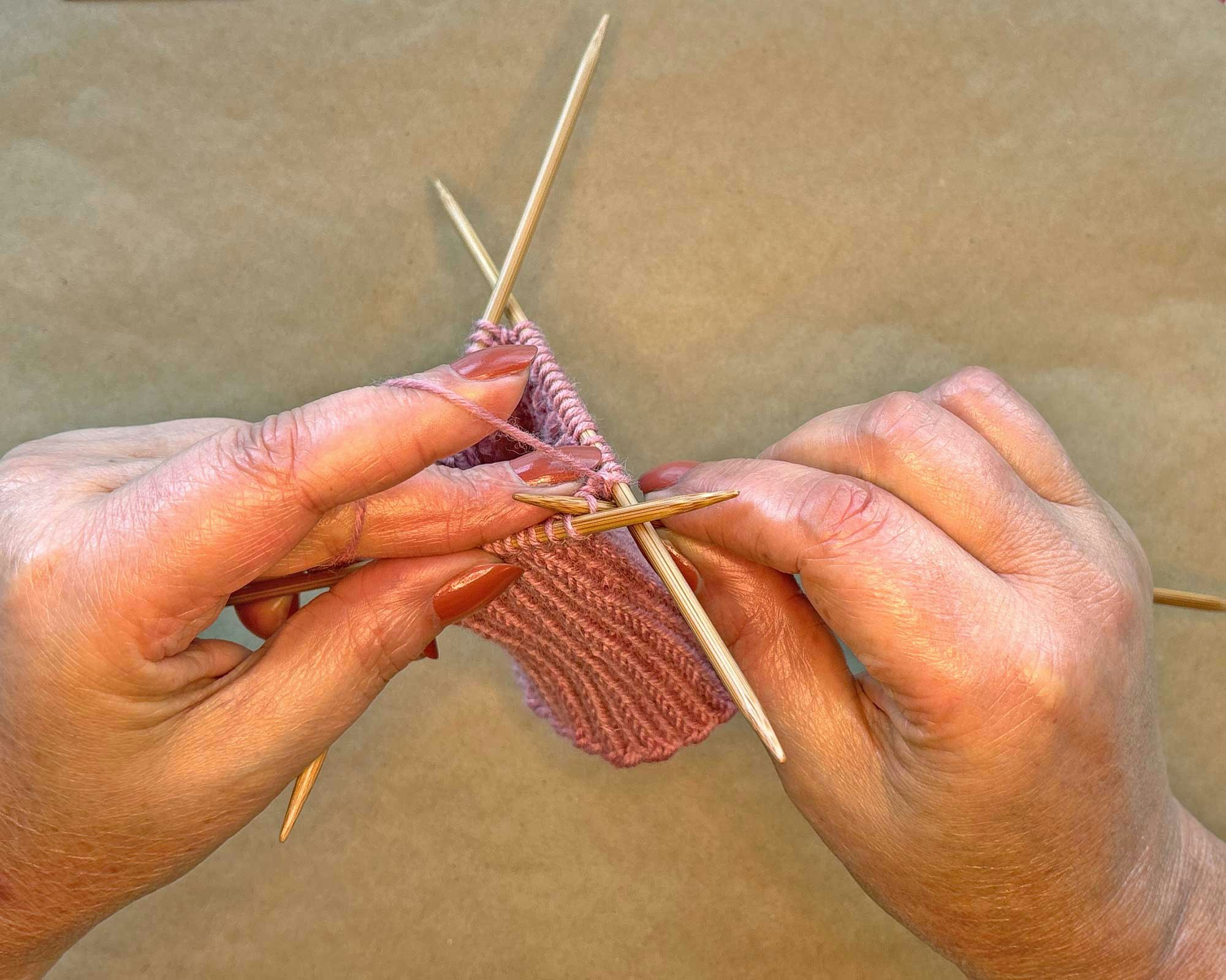
The stitches are divided over three double-pointed needles. The fourth needle is ready to knit the stitches along the base of the triangle.
The stitches are divided among three needles arranged in a triangle, or four needles
SUBSCRIBER EXCLUSIVE
Unlock the Full Article with a Farm & Fiber Knits Subscription
Get instant access to this article and the entire Farm & Fiber Knits library of projects, inspiration, and expert instruction. With your subscription, you'll receive:
Connect more deeply with your yarn—learn the stories of farmers, shepherds, and dyers
Knit patterns that celebrate natural fibers and slow, intentional making
Support a community of small farms, women makers, and independent yarn companies
Includes print and digital issues of Farm & Fiber Knits, delivered directly to you
With must-knit projects and unforgettable stories, Farm & Fiber Knits invites you to see the craft world through fresh eyes.
Plans start at just $5.83/month (paid annually). Cancel anytime.
If you want to spark a debate in a group of knitters, just ask which needle style is best for knitting small pieces in the round. I can think of five possibilities, and all have fervent devotees. Let’s look at the options and discuss the pros and cons of each.
Double-Pointed Needles
The circular needles we all know and love did not exist before the early twentieth century. Knitting in the round was traditionally done using a set of four or five double-pointed needles. This remains the method of choice for many knitters (including me!).
Get a closer look! Click any image in the gallery below to open it in full-screen mode.
The stitches are divided over three double-pointed needles. The fourth needle is ready to knit the stitches along the base of the triangle.
The stitches are divided among three needles arranged in a triangle, or four needles[PAYWALL] arranged in a square. The fourth or fifth needle is the “working” needle, used to knit the stitches. As each needle is emptied, it becomes the “working” needle and is used to the knit the stitches from the next needle in the round.
Pros:
- Double-pointed needles are available in a wide range of sizes and prices at craft and yarn stores everywhere.
- Knitting with double-pointed needles is compact. There are no loops of cord, no loose needle tips flopping about.
Cons:
- Some knitters end up with columns of loose stitches, or “ladders”, at the points where two needles meet.
- If you’re a loose knitter using slippery yarn and metal needles, the needles might fall right out of the stitches.
Magic Loop
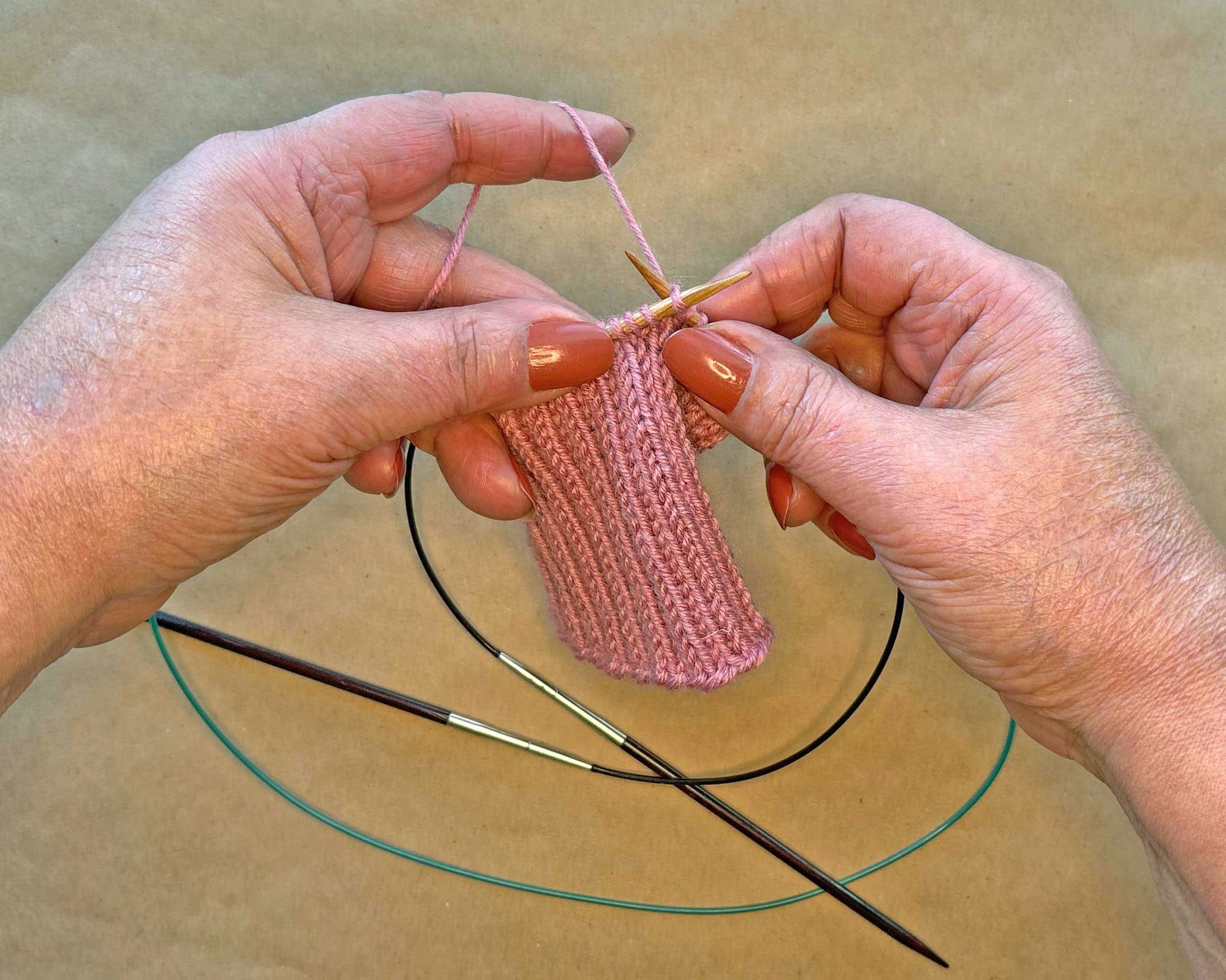
The Magic Loop method was developed by knitter Sarah Hauschka in the 1980s and popularized in a booklet called The Magic Loop published by Fiber Trends in 2002. One long (32–40") circular needle holds the stitches, with half the stitches positioned at the needle tips and the other half resting near the middle of the needle cord. The excess cord is arranged in loops separating the two halves.
For Magic Loop, half of the stitches rest at the center of the needle cord, while the other half are at the needle tips. The excess cord is arranged in loops on each side.
Pros:
- Magic Loop is the method for minimalists. Instead of collecting needles in a variety of lengths, a single long needle can be used to knit anything from a blanket to the finger of a glove.
Cons:
Rearranging the needle twice in each round can slow down your knitting.
Some knitters end up with columns of loose stitches, or “ladders”, at the points where the cord loops emerge from the knitting.
Two Circular Needles
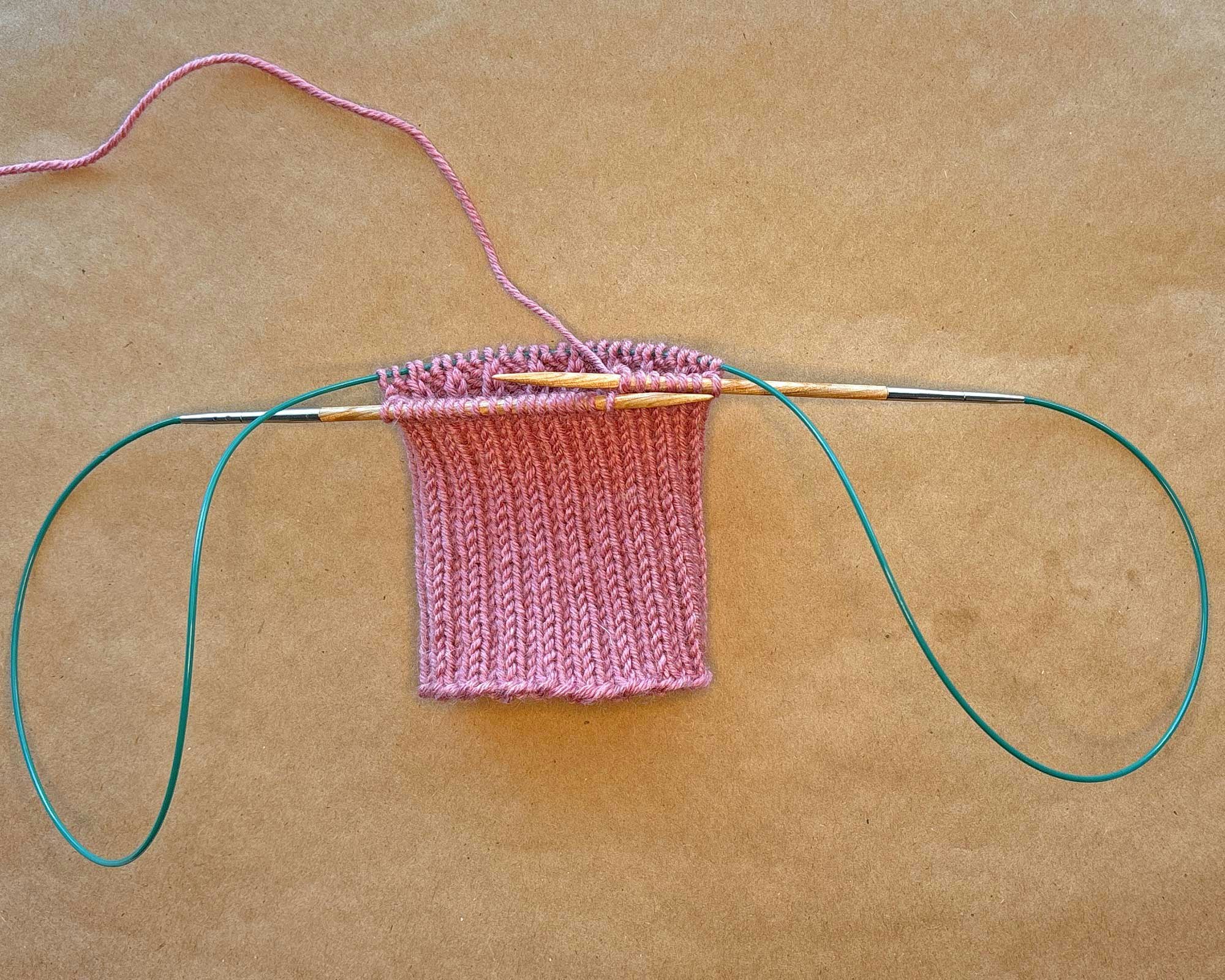
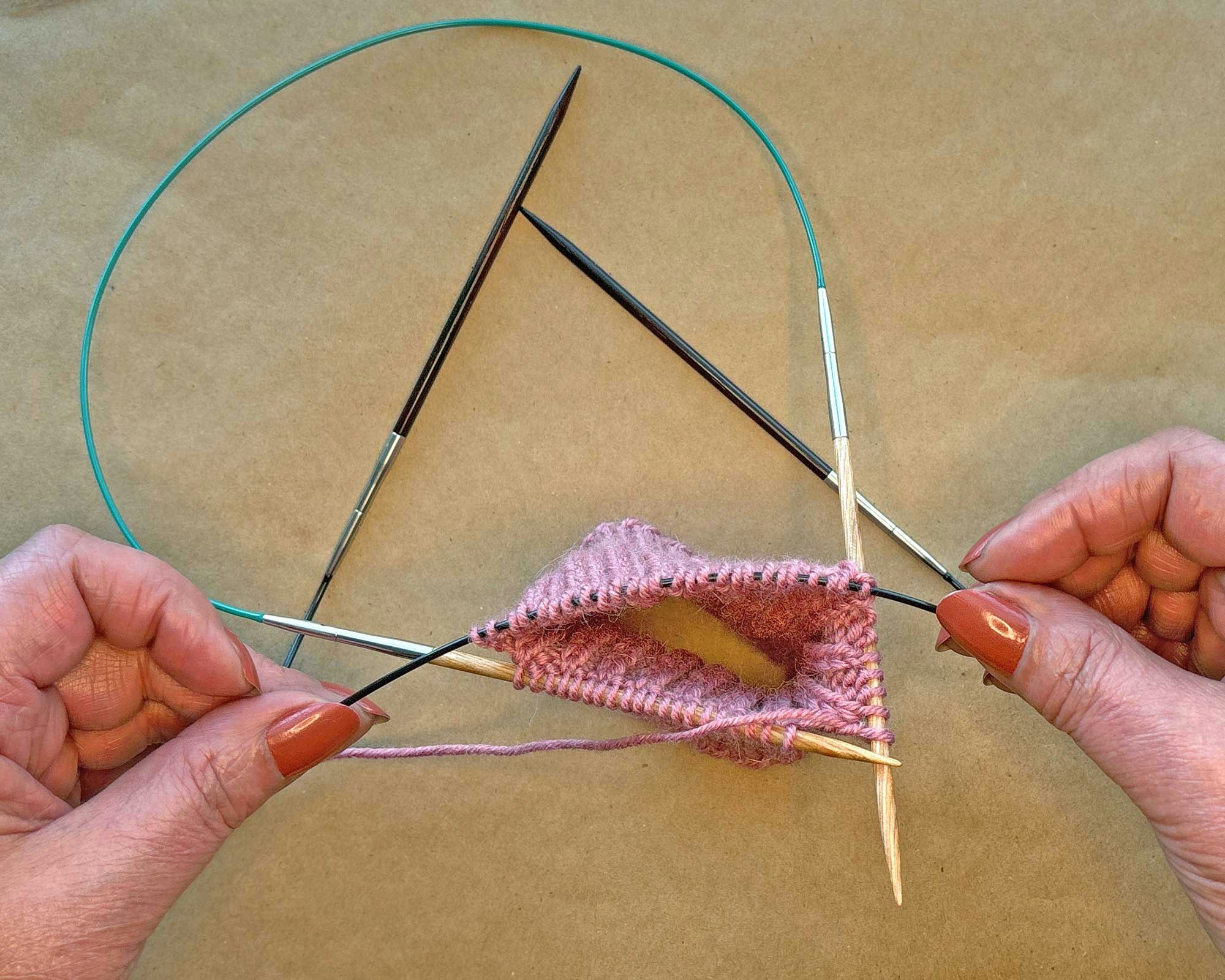
Knitting in the round on two circular needles was popularized by Cat Bordi in her 2001 book Socks Soar on Two Circular Needles. The stitches are divided among two circular needles, usually 24" long. Each needle is used to knit its own half of the round throughout. The tips of the needle not in use simply hang down awaiting their turn.
The stitches are divided between two circular needles. Using needles in two different colors can help beginners keep everything in order. In this example, one needle has dark tips and a black cord; the other has light tips and a green cord.
The two-circular needle method is often used when knitting both socks of a pair at the same time, with one needle holding the front/top of the foot of both socks, and the other needle holding the back/heel/sole of both socks.
Pros:
- Some knitters find this method easier and faster than Magic Loop.
Cons:
This method requires purchasing two needles of the same size.
The needles and yarn can easily become entangled when they are hastily tucked away in a project bag.
If you knit at a table, the tips of the needle not in use will knock against the table while you’re knitting.
Short Circular Needle
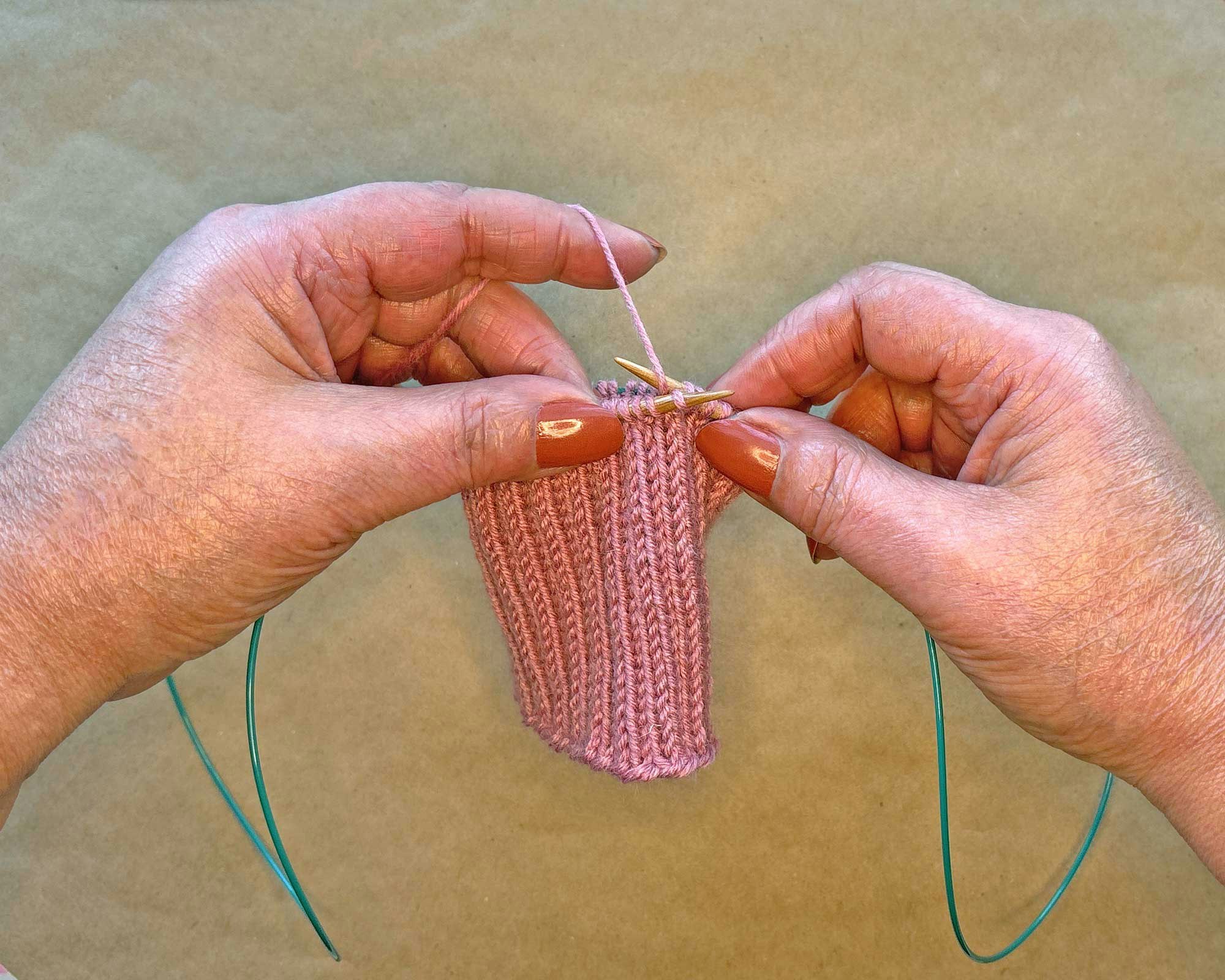
Many sock knitters enjoy working with a circular needle 9" long. This circumference works for most adult socks, mittens, and sleeve cuffs.
 With a 9” circular needle, there is no need to shift needles or manage excess cord. But your hands may not be comfortable working with such short needles.
Pros:
Knitting with a short circular needle is simple and fast. No switching from one needle to the next, no rearranging loops of cord—just knit.
There is no opportunity for “ladders” to form, since there is no division of the stitches.
Cons:
To achieve the 9" circumference, the rigid section at the needle tips is very short. Knitters with larger hands may find it uncomfortable to have so little to grip.
Short circular needles are a specialized tool, too long for mitten thumbs and too short for hats. You’ll need to have other needles at hand when it comes time to shape the toes of your socks or the tips of your mittens.
FlexiFlips
Developed by knitter Sylvie Rasch in collaboration with the needle manufacturer addi, FlexiFlips were introduced in 2017. Sold in sets of three, these hybrid double-pointed needles have a short flexible section in the center. The stitches are divided over two needles, with the third needle used as the working needle. As each needle is emptied, it becomes the working needle for the next half of the round.
 To knit with FlexiFlips, divide the stitches over two needles. Use the third needle as your working needle.
Pros:
Knitting with FlexiFlips may be faster than using traditional double-pointed needles, since there are only two needle shifts per round.
FlexiFlips are more compact than the circular needles used for Magic Loop or the two-circular needle method.
Cons:
These newer needles are not as widely available as traditional needle styles, though they are easily sourced online.
A set of FlexiFlips costs nearly double the price of a set of traditional double-pointed needles.
Which Option is Best?
Any of these needle options will get the job done. While double-pointed needles are my first choice, there have been many occasions when I’ve found myself away from home with a rapidly decreasing project on a circular needle. Using Magic Loop enabled me to keep on knitting.
If asked which is easiest, most knitters will name the method they learned first. Try them all and see which are most comfortable and efficient for your individual knitting style and project preferences. If you’re reluctant to invest in needles you might not like, ask around. You might be able to borrow from a friend, or your local yarn store owner may invite you to sit down and test-drive a set in the store.
Resources
Sandi Rosner has been a devoted knitter for more than 50 years and works as a freelance designer, writer, and technical editor. When she isn’t knitting, she usually has her nose in a book.