
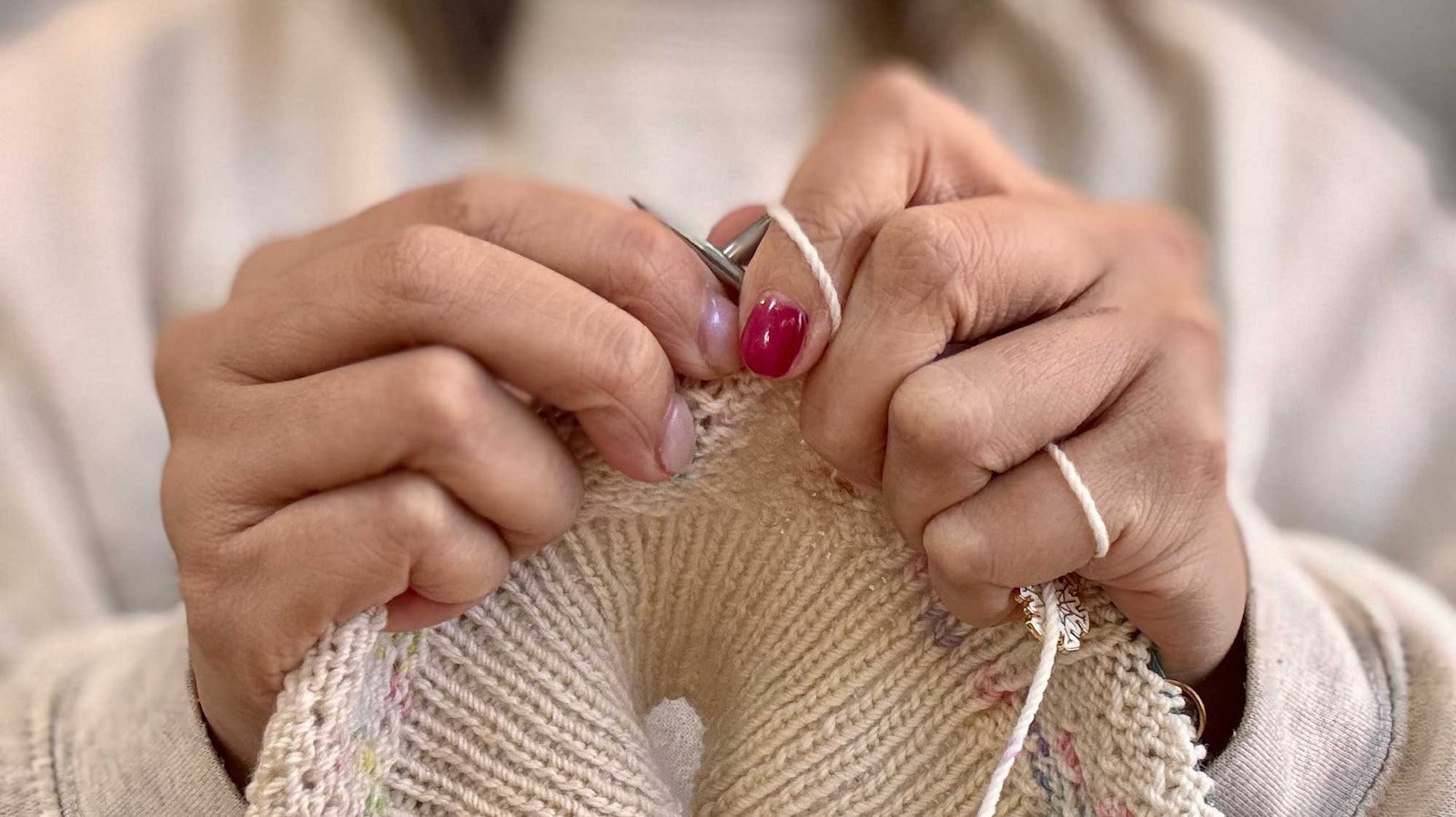
Whether you are picking up knitting needles for the first time or you’re a seasoned, serial knitter, you may have experienced some discomfort in your body from crafting. This discomfort can come from a combination of poor ergonomics, prolonged sitting, repetitive motions, or holding tension in the body for long periods of time.
Mind Your Posture—and Your Grip!
While every knitter is different, there are some common ergonomic challenges I see again and again. One of the most common is a forward head posture. This doesn’t just happen while knitting—it also shows up when we look down at our phones, work at computers, or while driving a vehicle. Ideally, the ears should be stacked over the shoulders, with the chin gently tucked back. This allows the appropriate muscles to support the weight of the head on top of the neck. For every inch the head shifts forward, the neck experiences roughly an extra 10 pounds of force, which can quickly lead to neck and upper back discomfort.
 Being mindful of your head position can prevent neck and upper back discomfort while knitting or performing other crafts.
Another common issue is excessive tension in the hands and wrists. This often happens when knitters grip their needles or yarn too tightly, especially during long or challenging projects. The muscles that control the fingers and wrists actually originate near the elbow and travel down the forearm into the hand. Because of this, pain or tightness can show up anywhere from the elbow down into the hand. This is one reason knitters sometimes develop conditions like “tennis elbow” or “golfer’s elbow,” even if they’ve never picked up a racket or golf club.
One simple and effective way to ease muscular discomfort is through stretching. Stretching helps lengthen tight muscles and encourages blood flow to areas that may have been working overtime. The stretches below can be done after a long knitting session, as a quick break during knitting, or as a gentle warm-up before you start. Please note that if you experience any sharp pain, you can lessen the intensity of the stretch but mild discomfort while stretching is normal. Remember to take deep breaths to allow your body to relax into the stretch!
 Performing the prayer stretch—before, during, or after a knitting session—can ease discomfort and promote blood flow.
Prayer Stretch
Place your palms together in front of your chest, lining up your fingers and hands. Keeping your palms and fingers in contact, slowly lower your hands while allowing your elbows to move outward toward the sides. Stop when your forearms are roughly parallel to the ground and you feel a stretch through your wrists and forearms. Hold for 30 seconds, then relax. Repeat as often as feels helpful.
 The levator scapula stretch helps reduce stiffness and pain in the neck and upper back.
Levator Scapula Stretch
This stretch targets the levator scapula muscle, which is commonly overworked with forward head posture. This muscle runs from the base of the neck to the inner edge of the shoulder blade. Begin by sitting up tall. Place your right hand on your head and gently turn your head to the right, as if you are looking toward your right elbow. Lightly tuck your chin and allow the weight of your hand to guide your head downward. You should feel the stretch along the left side of your neck and toward the top of your shoulder blade. For a stronger stretch, you can sit on your left hand to help keep the left shoulder relaxed and down. Hold for 30 seconds, then repeat on the opposite side.
Incorporating simple stretches like these into your knitting routine can go a long way toward reducing stiffness and discomfort.
In Part Two of this series, we’ll explore additional ergonomic strategies to help knitters stay comfortable and enjoy their craft for years to come.
Visit Andrea at ptandrea.com or on Instagram, TikTok, and YouTube as TheKnittingPT.