
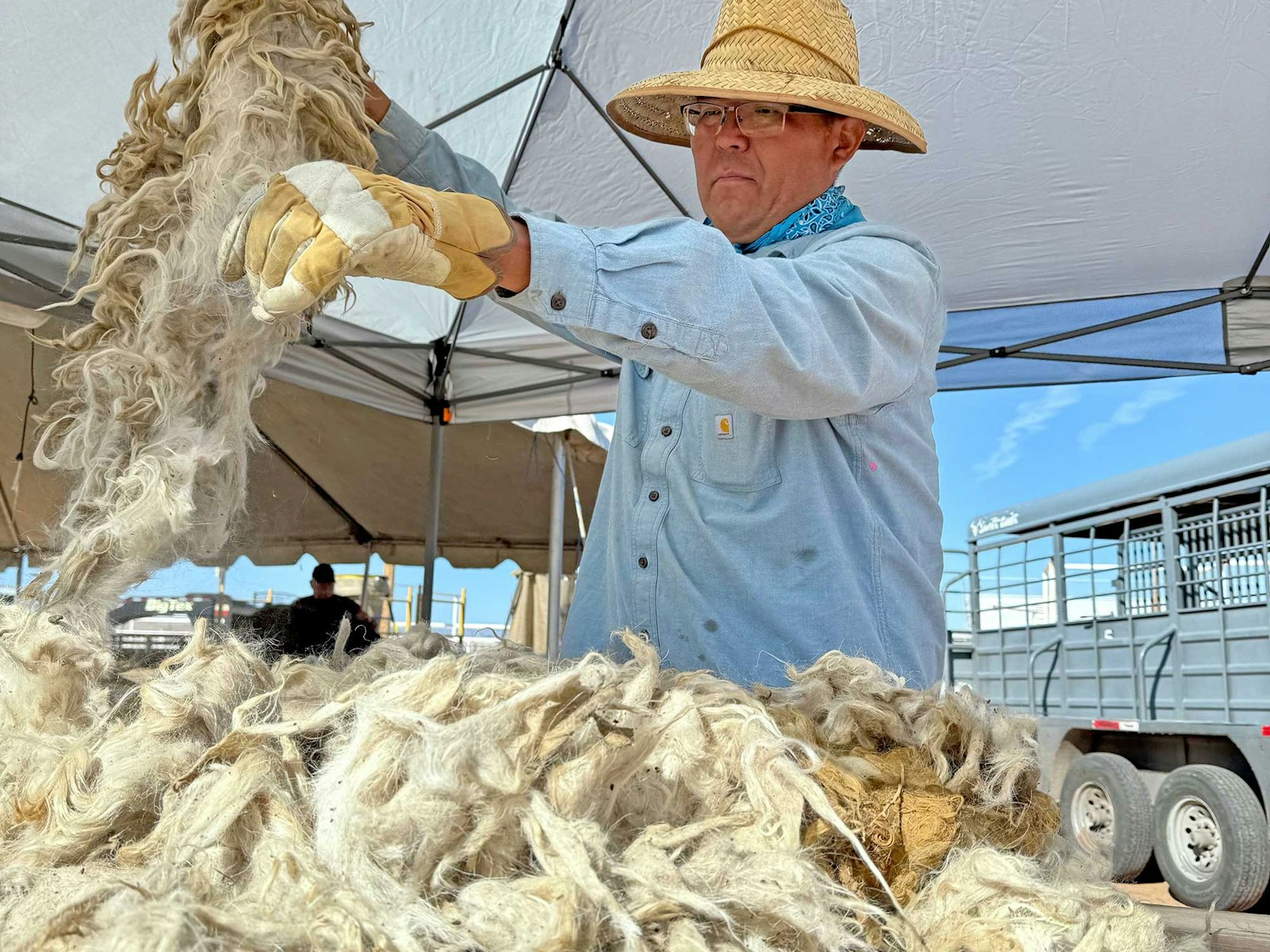
There is nothing like preparing for a wool buy on the Navajo Nation. First, you must lovingly raise the sheep, kindly harvest and package their fleeces in the spring, and prepare to arrive at the wool-buy location on the day. Producers will start lining up by 5 a.m. to ensure their precious wool is purchased. It’s a busy, strenuous, exhausting time.
Before the era of annual wool buys, local trading posts were the go-to for producers to sell their wool and mohair. At one point, Navajo wool had humbly made its place in the global market, providing millions of pounds of raw wool for the carpet-manufacturing industry. There was a time when this provided a decent livelihood for Diné shepherds.
Today, most Diné would agree that “back then,” raising sheep for wool and meat, as well as Angora goats for mohair, was their family’s main source of income. My father recounts the days of packing wool during shearing season. His mom had a tall, wooden stand specially made to hold up a long burlap bag. That bag was then filled with freshly shorn and skirted wool that he and his brothers would stomp down to pack as much wool into one bag as they could. He said that one trip into town with those burlap bags full of wool in the spring—and then a trailer load of weaned lambs in the fall—would purchase clothes, shoes, school supplies, food, and everything they needed to survive the winter with their sheep.
 Diné College Land Grant Office interns pack wool into burlap bags.
Over the years, the wool market has plummeted due to imposed and retracted duties on wool, thus crumbling the foreign and domestic infrastructure needed to process wool and mohair. Today, producers send their wool to what is known as a “wool warehouse,” where the wool will be consigned and placed into a global auction to get the best price for both the producer and the wool company.
How Does a Wool Buy Work?
A successful wool buy on the Navajo Nation begins with a dedicated crew of about 20 to 30 people, each assigned to different tasks. There are the runners, who go down the line of vehicles, handing out clipboards of paperwork and tagging the bags of fiber, labeling them either fine, medium, coarse, Merino, Rambouillet, Mixed, Unknown, Churro, or Mohair. When the producer makes it to the weighing area, the crew that unloads the wool and packs it on the scale will sort the wool as the reader reads and records the weight and type of fiber aloud so those writing the checks know what they’re paying for.
 A Diné shepherdess watches as her wool is weighed.
The wool is then skirted by a team of handlers removing dung and debris. This team is led by a professional wool grader who then grades and sorts the wool into more specific categories based on quality. Groups of about three people to a wool stand then pack the graded wool into burlap bags, which will then be loaded onto trailers to transport the wool to nearby warehouses. The Diné College Land Grant Office has a square baler for wool, so off-site and after a buy, the wool is again removed from the burlap bags and baled into large square bags for easier shipment to the wool warehouse.
 A team of professional wool graders sorts the wool before it is packed into large burlap bags.
In years past, the wool buys were run by groups such as Mid-States Wool Growers Cooperative Association, Peace Fleece, and Restoration Yarns. Other small groups such as Black Mesa Weavers for Life and Land as well as Rainbow Fiber Co-Op worked with Diné shepherds who raise Navajo-Churro sheep. Today, the wool buys on the Navajo Nation are organized by the Land Grant Office at Diné College and the Navajo Nation Department of Agriculture. The Navajo Nation is the primary buyer, and USDA representatives are onsite to help producers sign up for an additional monetary incentive. The wool and mohair that was purchased in 2024 was stored at Navajo Nation warehouses until a wool broker in Sonora, Texas, was ready to receive it. The wool that is purchased this year will go through the same process and—fingers crossed—will sell into the global market.
Knit the Rancher’s Cowl
Navajo knitwear designer, weaver, and maker Tressa Weidenaar calls Gallup, New Mexico, home, and the vast landscapes of the Southwest serve as a constant source of inspiration for her creations. Where Tressa lives in New Mexico, the spring winds are often harsh and powerful, and cowls are useful to help keep dust and cold air out of one’s shirt and jacket.
The motifs in her Rancher’s Cowl reflect patterns you might see in Navajo weaving. Wear it like a mini poncho to add an extra layer of warmth for the shoulders.
 Many of Tressa Weidenaar’s designs reflect elements of her home so that she can take them with her wherever she goes. The patterns and colors in her Rancher’s Cowl are comforting to Tressa and help her remember the land and the people that she comes from. Photo by Gale Zucker