
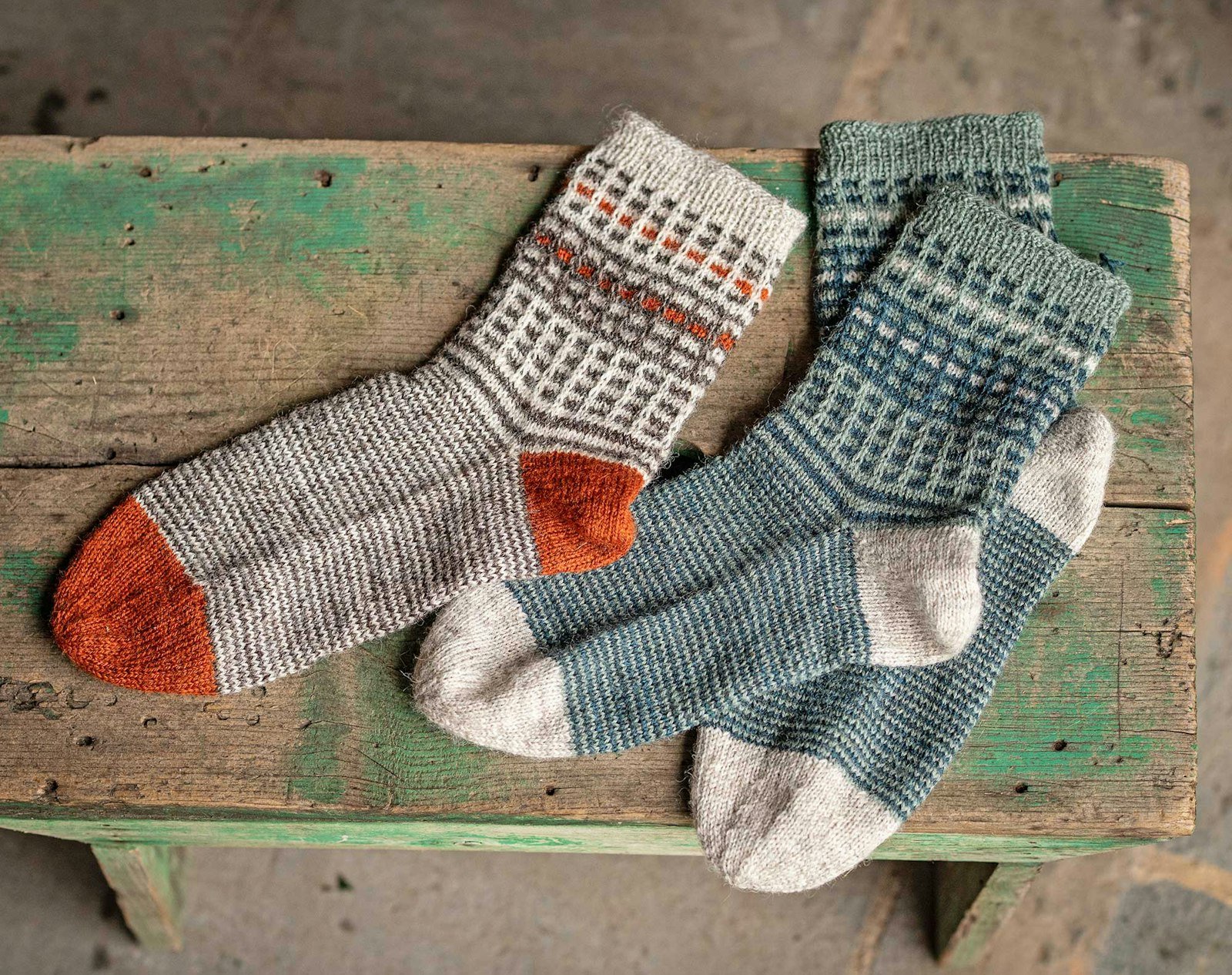
This sock saga started when I fell hard for Snowdonia Sock from Garthenor Organic as I passed by their booth at the New York State Sheep and Wool Festival. I was drawn in by the tidy, colorful skeins and couldn’t stop handling the toothy yet silky Romney/Hebridean fiber blend grown and spun in Wales.
Garthenor Organic focuses on knowing where the wool comes from and how it is processed, often sourcing fleece directly from specific farms and flocks. Starting in 1999 as a small organic farm in Wales, Garthenor became the first company in the world to produce a fully certified organic wool yarn in 2003. Every stage—from sheep to finished skein—is certified under the Global Organic Textile Standard (GOTS).
Fleeces from the two British sheep breeds included in the Snowdonia blend are known for strength and durability. Romney is a strong, wavy wool, and Hebridean is an old breed that still retains its mix of long silky fibers and short soft fibers.
As I hand-wound my sweet skeins from the festival, I vaguely remembered reading something about Welsh striped stockings. Down the wooly rabbit hole I went.
 Snowdonia Sock also comes in natural colors. Photo by Kate Larson
Off to the Museum
While I have traveled internationally just to look at antique socks (true story), this was a digital excursion. I headed to the Museum Wales online collection and found some beautiful nineteenth-century stockings—here are a few. Among the collection is a pair by Miss Ann Jones (below), knitted around 1870. Unworn, each sock is embroidered with Ann’s initials and has several different striping patterns from cuff to toe: wide eight-round stripes, wide chevron stripes, single-row stripes, and two-row stripes with an interesting slip-stitch check.
 Stockings by Miss Ann Jones (45.338.1-2), circa 1870. By permission of Amgueddfa Cymru—Museum Wales
I love Ann's mix of stripes and decided to take her lead when I cast-on my own stripy socks. Eventually, my Cymru Socks would include three different stripes in three colors of Snowdonia Sock yarn: a four-row slipped stitch pattern inspired by Ann's socks, two-row stripes, and single-row stripes. The nation of Wales, Cymru in Welsh, is pronounced kum-ree.
The Jogless Jog
When we knit in the round, we are creating a spiral. So, if we work rounds of different colors, it can create what knitters call a "jog" and colors don't line up in perfect stripes. The Cymru Socks pattern includes two different jogless-jog techniques to keep stripes tidy: single round and double round. Single round stripes are so easy and fun to knit using helical knitting techniques. Try it three different ways to see what you like best!
 Photo by Kate Larson
The rule for helical knitting is to not cross the yarns. Here, the working blue yarn is at the end of the round. Dropping blue to the right and picking up green to the left so that the yarns do not twist or cross will keep stripes uninterupted. It's as simple as that! If you are new to helical knitting, there's a good primer at the link above.
Stripes and slipped-stitch stripes are a great way to incorporate color without the strands or tension challenges of colorwork knitting. I hope you'll give it a try!
— Kate
 Inspired by historic Welsh stockings and modern Welsh wool, these colorful socks are worked in the round from the top down in surprisingly easy stripe motifs.
Cast on a pair! Find the Cymru Socks in the Farm & Fiber Knits Library.
Resources
There are several great ways to knit perfect single-row stripes in the round. The Cymru Socks pattern uses both helical knitting for single-row stripes and a slip-stitch jogless-jog method for two-row stripes. Learn more at “What Is Helical Knitting? Learn 3 Ways.”
Discover more about Romney’s lustrous, durable wool in "Broaden Your Fiber Horizons: Knitting Beyond Merino."
Get a glimpse of Connecticut’s Olympia Farm and their flock of Romney sheep in “Snuggly Goats and Wooly Hydroponics."