Subscriber Exclusive
Sizing an Open-Front Cardigan: What the Pattern Really Means
No-button cardigans play by different rules. Here’s how to read the numbers.
No-button cardigans play by different rules. Here’s how to read the numbers. <a href="https://farmfiberknits.com/sizing-an-open-front-cardigan-what-the-pattern-really-means/">Continue reading.</a>
https://farmfiberknits.com/cdn-cgi/image/format=auto/https://www.datocms-assets.com/101500/1776352699-open-front-cardi-header.jpg?auto=format&w=900
When we choose a size for the sweater that we want to knit, we usually think about the bust or chest circumference (or sometimes the upper chest circumference).
This works very well for a pullover, where it’s easy to tell the finished size of the sweater: the circumference at the underarm if worked in the round, the width of the front and back minus the seam stitches if worked in pieces. To find your size, measure your chest, add extra for ease, and you have an estimate of what size you should choose for the finished sweater.
For a cardigan with a button band that is intended to be buttoned, the body circumference is calculated similarly: measure the width of the fronts and back plus the width of one band, because the bands overlap when the cardigan is buttoned. The widths of the two fronts plus one band is usually equal to the width of the back.
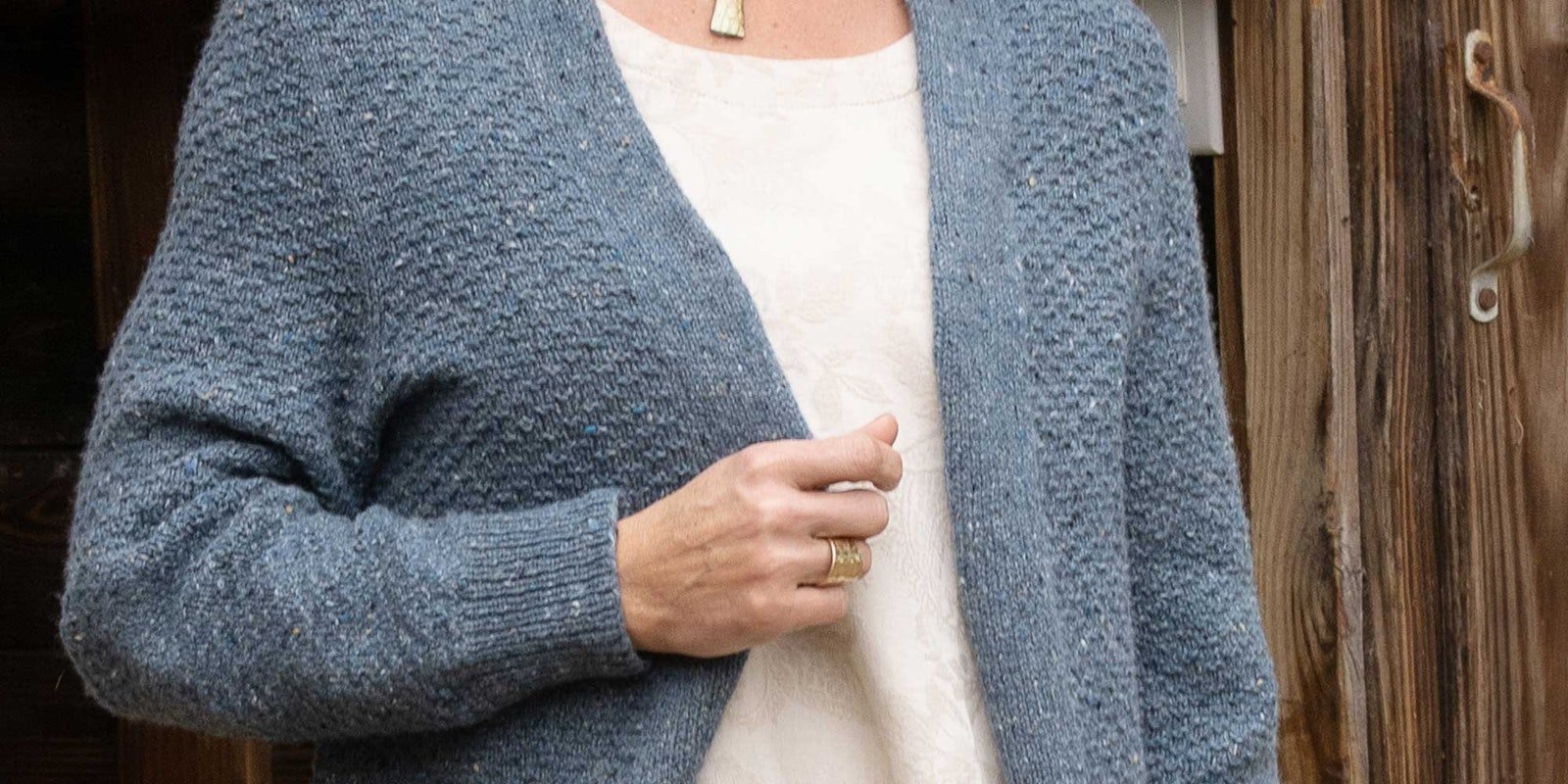
 The fronts of the Morland Cardi by Alison Green are designed to hang open, with a stockinette front band that curls in gently.
When the Fronts Don’t Meet
But what if your cardigan doesn’t button in the front—in fact, what if the fronts don’t meet at all?
SUBSCRIBER EXCLUSIVE
When we choose a size for the sweater that we want to knit, we usually think about the bust or chest circumference (or sometimes the upper chest circumference).
This works very well for a pullover, where it’s easy to tell the finished size of the sweater: the circumference at the underarm if worked in the round, the width of the front and back minus the seam stitches if worked in pieces. To find your size, measure your chest, add extra for ease, and you have an estimate of what size you should choose for the finished sweater.
For a cardigan with a button band that is intended to be buttoned, the body circumference is calculated similarly: measure the width of the fronts and back plus the width of one band, because the bands overlap when the cardigan is buttoned. The widths of the two fronts plus one band is usually equal to the width of the back.
The fronts of the Morland Cardi by Alison Green are designed to hang open, with a stockinette front band that curls in gently.
When the Fronts Don’t Meet
But what if your cardigan doesn’t button in the front—in fact, what if the fronts don’t meet at all?[PAYWALL]
In that case, it doesn’t make sense to use the full circumference as the finished size, because that doesn’t take the gap at center front into account.
 Illustration by Karen Frisa
For example, let’s look at this cardigan. The back measures 18" wide, and each front measures 5½" wide. The sweater itself measures 5½" + 18" + 5½" = 29".
But to say that the cardigan measures 29" would be misleading, because when you wear it, it will be open at the front, even after adding a button band or edging (which the schematic generally doesn’t show). That opening is effectively part of the circumference of the cardigan.
One way to address this is to pretend that the fronts (together) measure the same width as the back. This is tempting, because the back of a sweater generally measures the same width as the front, so it’s a measurement that we’re comfortable with. But stating the finished size in this way usually leads to confusion. For our example sweater, the pattern could say that it measures 36" in circumference with a 7" gap at center front. Reading the pattern, you might wonder whether the 7" gap is already included in the 36", or if it needs to be added. In other words, does the cardigan effectively measure 43"?
 The fronts of the Morland Cardi don’t meet or overlap in front, so what size should you make?
To further complicate things: how much of a gap will there actually be at center front when you wear the garment? If the sweater were laid flat, there is a 7" gap. But the gap when worn will partly depend on the wearer’s chest circumference, and we can’t take that into account.
Instead, the pattern lists the width of the back of the sweater. This gives you an idea of how it will fit across your back and removes the confusion about how wide the gap at center front might be.
 The pattern gives the finished size of the Morland Cardi as the back width.
How to Choose a Size
There are a couple of options for choosing which size to make:
1. Measure across your back at the underarm (starting and ending where the side seams would be), add some amount for ease (half the ease you’d choose for the full circumference), and choose that size.
 Measure from seam to seam as shown.
This width across the back is not the same as the cross-back measurement, which sewing patterns (and even some knitting patterns) include. The “cross-back width” sometimes measures from armhole seam to armhole seam across the back, or sometimes from shoulder to shoulder, either of which may be a similar number but is not the same.
2. Double the back width of a size, which tells you the circumference that the sweater would measure if it were a style where the fronts met and closed. Use that circumference estimate to choose a size as you usually would, based on the amount of ease you would like for your piece. For example, if the listed back widths were 18¼ (20¼, 21¾, 24, 26¼) (28¼, 29¾, 32, 34¼)", you could double them to 36½ (40½, 43½, 48, 52½) (56½, 59½, 64, 68½)", then choose a size to give you the amount of ease that you prefer.
So hunt up your tape measure and cast on with confidence!
Find the pattern for the Morland Cardi by Alison Green in the Farm & Fiber Knits Library or in the Summer 2026 issue.