
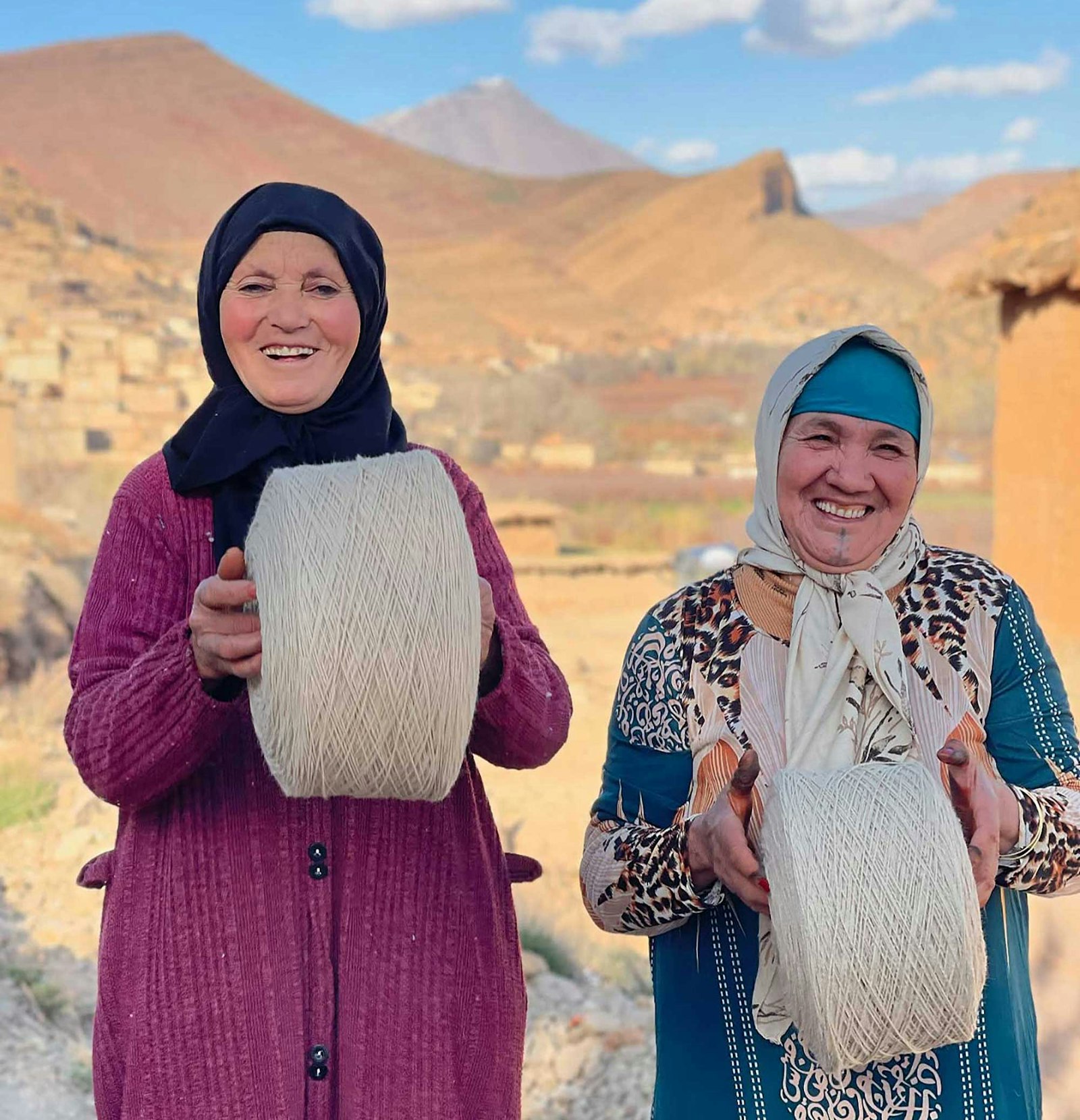
In the High Atlas Mountains of Morocco, a new kind of wool mill is quietly taking shape, one built not only to spin yarn, but to recalibrate an entire ecosystem. The project grew out of Anou, a cooperative founded in 2012 to connect rural Moroccan artisans directly with global markets. Cofounder Dan Driscoll began Anou’s digital platform to help makers in Morocco bypass exploitative middlemen. That work has evolved into something more ambitious: a vertically integrated wool operation designed to serve artisans first—and the land alongside them.
 Left: The Anou Co-Op’s yarn shop in Fez displays yarns fresh from the Atlas Mill. Right: A trial batch of premium Tamazirt wool yarn. The mill is gradually expanding the variety of wool it processes to accommodate regional artisans.
Wool as a Measure of the Land
Driscoll, the visionary behind the Atlas Wool Supply Company, did not come from a textile design background. Trained in environmental science and originally arriving in Morocco as a Peace Corps volunteer, he sees wool not simply as fiber but as a proxy for environmental health. “Wool reflects everything,” he says. “How sheep are raised. How land is managed. How water is used. How chemicals are handled. If you follow the wool, you see the system.”
Morocco is the sixth-largest wool producer in the world, Driscoll explains, yet exports none of it as finished yarn. Instead, most wool is sold raw or processed through systems that prioritize speed and cost over quality and sustainability. Local artisans struggle to access consistent, high-quality yarn at home. The contradictions were impossible to ignore.
 A custom-ordered rug, crafted by the Nahda Co-Op from soft and bulky 2-ply, zero-wash yarn, is inspected at the Anou headquarters in Fez. Managing the quality and sustainability of materials for rug weaving was the impetus for starting the Atlas Wool Supply mill.
The Dye Crisis That Changed Everything
The turning point came in 2016 while Anou was fulfilling custom handwoven rug orders requiring an increasingly varied range of yarn colors. Traditional dye houses produced the precise colors Anou rug weavers needed, but something was wrong. Artisans using the newly dyed yarns complained of persistent “colds.” When yarn was brought to Anou’s headquarters for testing, the issue appeared linked to harsh chemical mordants and fixatives embedded in the fiber. The cooperative shut down temporarily as they determined how to bring dyeing in-house and control the process.
What followed was months of experimentation. Dyeing proved both magical and mathematical: weight-of-fiber ratios, precise temperatures, predictable outcomes. But the inconsistencies ran deeper than color. Wool purchased from markets often contained synthetics. Acrylics and other polymers disrupted dye formulas and compromised quality. The conclusion was inescapable: to control dye, they had to control yarn. To control yarn, they had to build a mill.
 The Atlas Wool mill built at about 6,000 feet in the High Atlas mountains. The company used traditional architecture and construction methods when building the mill and operate it completely with solar power.
Building a Mill in Sheep Country
In 2021, the Atlas Wool Supply Company finally broke ground outside Aït Bouguemez in the high Atlas Mountains in a region defined by grazing land and agriculture. The location was deliberate—close to shepherds, close to fiber, embedded in the landscape that sustains both. Financing came not from foundations but from private impact investors—individuals drawn to materials, cooperatives, and regenerative systems. Atlas Wool’s mission was clear: provide Anou cooperative artisans with weaving yarn at cost, use larger-scale production to fund environmental improvements, and export high-quality Moroccan yarn globally.
 Left: Atlas Wool Supply Co Director Brahim El Mansouri, along with community members, completed the mounting work and metal framing installation for the solar farm. Right: The team celebrates installation of the 100th and final solar panel. A rainbow appeared on both occasions.
Given difficulties connecting to the electrical grid, the team accelerated plans to take the mill entirely off grid. Over the next year, they constructed a solar power system capable of running a small factory in extreme mountain conditions—an environment marked by rapid temperature shifts and fluctuating humidity. The mill turned on for the first time in April 2024.
Spinning yarn in the Atlas Mountains proved anything but “plug-and-play,” Driscoll remembers. Each season altered fiber behavior. Humidity changed tensile strength. Temperature shifts disrupted twist consistency. It took a full year of production to stabilize the process. By mid-2025, the mill was supplying custom-order yarn to Anou artisans.
 At left: Atlas Wool Supply Co. director Brahim El Mansouri teaches his daughters the process of yarn manufacturing. Right: The Anou shop in the Fez medina.
The Chemistry of Scale
As they evaluated the environmental challenges, they realized that washing and processing the wool was a key factor in reaching production scale. At first, the simplest solution seemed obvious: import a well-known industrial wool scour. But the detergent alone would have consumed nearly 60 percent of the target yarn price—untenable for a mill committed to selling yarn to artisans at cost. Worse, it meant shipping mostly water across the Atlantic and relying on a formulation whose full contents were unclear.
Environmental marketing around detergents is notoriously vague. Claims of “biodegradable” can mask ingredients that persist in fragile ecosystems. In Aït Bouguemez, where drought has strained an already delicate water table, dumping industrial chemicals into the watershed was not an option. The solution was to develop their own wool scour so they could control the ingredients and adjust the formula as needed.
Working with a chemist, they dissected what “biodegradable” truly means—genuinely capable of breaking down without bioaccumulation. The initial commercial formula failed that test. From there, they developed nearly one hundred formulations tailored specifically to wool. The machines became the arbiters of truth. If fibers gummed up rollers and disrupted spinning, the scour had failed. If production ran clean, the scour was successful. The result was a biodegradable wool scour designed for local ecological constraints and fiber performance.
 Atlas commits to hiring only women from the valley, who quickly master wool, yarn, and soap processing and manufacturing—gaining skills to utilize resources in their home valley and transform its future.
Rethinking the Wash
In conventional Moroccan rug finishing, completed rugs are aggressively washed—often using up to 100 liters of water per square meter, along with bleach and sulfate-heavy compounds to soften and brighten the wool. The Atlas Wool mill took another approach: gentler scouring, careful fiber sorting, minimal chemical intervention. The result? Rugs that emerged softer than their chemically stripped counterparts—without post-weaving washing, and without the huge water footprint. Softness came from preservation rather than force. By avoiding harsh bleaching, the wool’s natural structure remained intact. For a country where rug-washing runoff has degraded waterways, the implications are profound.
Beyond Wool: Soap as Strategy
The detergent experiments sparked a broader idea. If the team could reformulate wool scour, why not dish soap, laundry detergent, or hand wash? Many cleaning products globally lack ingredient transparency. Creating genuinely biodegradable alternatives could both reduce local environmental harm and generate revenue for Atlas Wool’s land regeneration goals. Today, cafés and riads throughout Morocco have begun using the mill’s soaps. Soap might be someone’s entry point into a much larger conversation about sheep breeds, drought, and watershed stewardship. This business model intertwines fiber and chemistry: revenue from specialty yarns and soaps can help fund regenerative grazing practices and ecological restoration.
 Sheep graze in the land around the mill. Part of Atlas Wool’s commitment to sustainability involves working with local shepherds, stewards of their land as well as their flocks.
Regional Wool, Regional Identity
Most of the mill’s wool currently comes from within a 100-kilometer radius, primarily from the Timahdite breed—a mountain sheep closely tied to Amazigh land and culture. The team plans to expand into other regional breeds and to tailor yarn lines not just to weaving, but to knitting and more industrial uses. The mill currently spins a wide range of yarns—from super bulky rug yarns to fine lace weights, which are rare in Morocco. Driscoll believes that Atlas Wool Supply will “be able to produce amazing yarns for much different purposes than just the strict traditional uses within Morocco.”
A Long Horizon
Atlas Wool’s vision blends ethics and pragmatism. “If we can’t win the moral argument,” Driscoll says, “we build a business strong enough that the right way becomes the necessary way.” By positioning the mill as a central hub for sustainable, quality Moroccan wool—while ensuring artisans access yarn at cost—the operation creates leverage. Anyone seeking authentic Moroccan wool at scale will eventually seek out the mill’s offerings. It is an ambitious strategy, rooted in the belief that scale and craft need not be opposites.
From the first spark of the idea in 2017 to operational production in 2024–2025, the journey has been dynamic. The early tone of revolution has matured into something steadier. There is confidence now in the data: softer rugs, cleaner runoff, stable yarn, and expanded artisan access. Whether global markets will fully recognize the value of regenerative fiber remains uncertain. But in the High Atlas, wool is no longer just a material. It is infrastructure. It is environmental policy. It is economic strategy. And, perhaps most importantly, it is a way of rooting craft back to the land that sustains it.
Further Reading
To learn more about the Atlas Wool Supply Company, visit atlaswoolsupply.co.
And find out more about The Anou cooperative, connecting rural Moroccan artisans directly with global markets.