
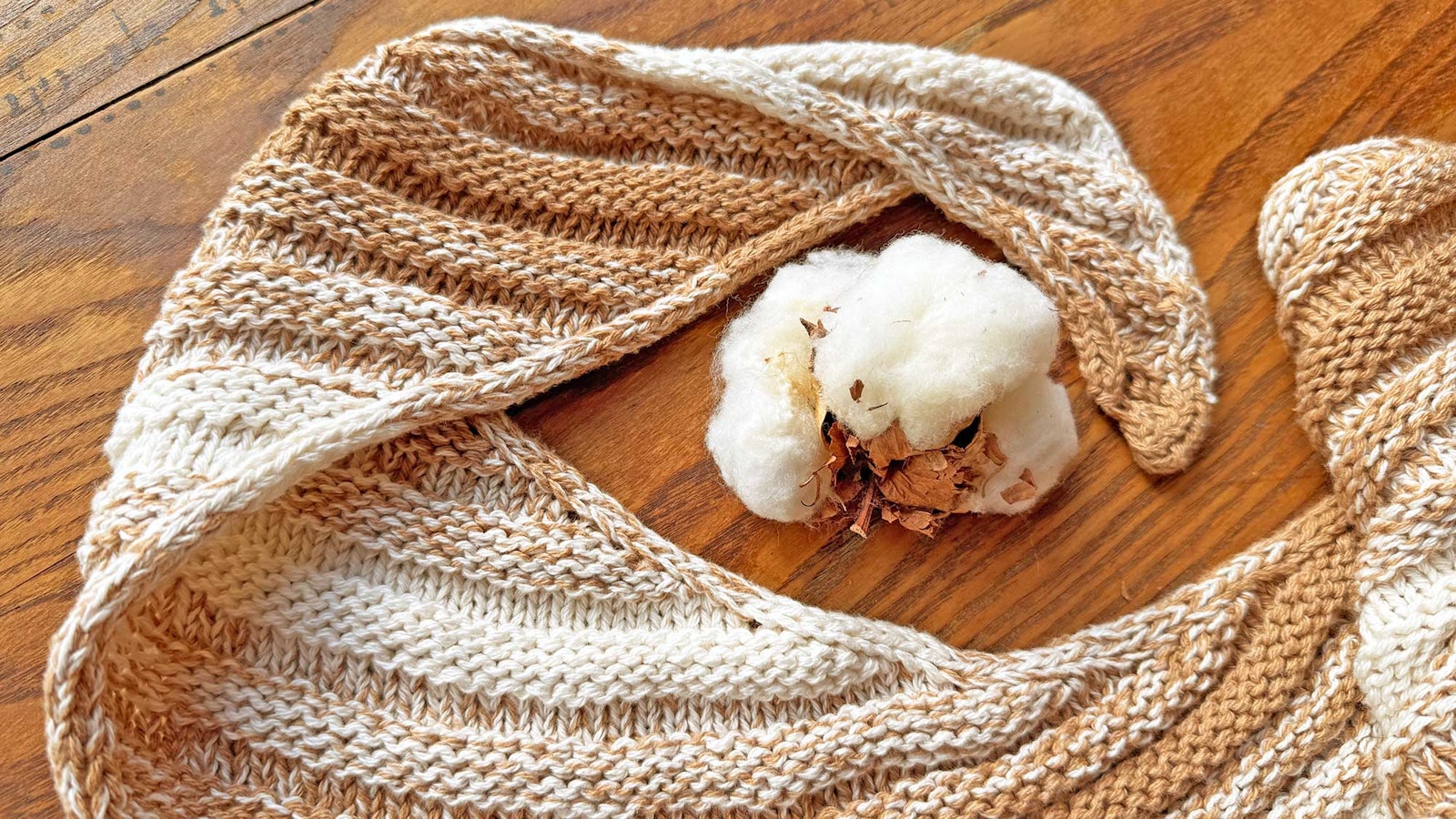
With our shift in 2026 to a quarterly print magazine (thank you, dear readers!), we are about to release our very first Summer issue. What better time could there be to dig into organic cotton yarns? We knitters have more options than ever, and many companies are giving us more information about where our fiber comes from and how it is processed. But what does “organic cotton” mean exactly? What is GOTS labeling? So many questions!
In her article, “What Is Organic Cotton?” author Stephany Wilkes answers these questions and more, and she introduces us to California cotton grower Sally Fox. Sally has developed organic cotton varieties that produce cotton in stunning browns and greens. These colorful cotton bolls are grown and harvested as part of a regenerative-farming method that Sally is passionate about.
 A brown cotton boll from Sally's farm and cones of her 10/2 cotton yarn. Photo by Matt Graves
Sally has her cotton spun into a variety of yarns and fabrics, and I especially enjoy working with her 10/2 cotton, which is what we knitters would call a laceweight yarn. When three strands are held together, I find it works up like a sportweight yarn. Holding three strands at once also gives us great color-mixing options.
The Furrow Scarf
Here is the sneak peek! I can't wait for you to see this sweet little scarf, knitted on the bias like an asymmetrical shawl. I knitted it in three different organic cotton yarns, and I also used three different approaches to color: chunky stripes, a solid color, and a gradient.
 Three Furrow Scarves (from top): Blue Sky Fibers Organic Cotton Sport, Appalachian Baby Designs US Organic Cotton Sport, and 10/2 Foxfibre. Photo by Matt Graves
Knit a Gradient
Naturally colored cotton deepens in color and intensity when washed. It’s fascinating to take a light yellow-green skein and watch it deepen into an olive green. I like to do this before I knit because the yarn relaxes and gains some loft and elasticity. And I just think it’s great fun to knit with vibrant color! My instructions for winding yarn off the cones, scouring, and drying are here: Why You Should Wash This Cotton Yarn (Before You Knit!)
Then, you are ready to start playing with color as you knit.
 Foxfibre 10/2 cotton (held triple). Kate finds that three strands is roughly sportweight. Photo by Matt Graves
The body motif of the scarf is a welt, and a pattern repeat is four rows of stockinette and four rows of reverse stockinette. I started by holding three strands of the same color to work one pattern repeat (eight rows), and then I would break one of the three and replace it with a strand of the contrast color. Replacing one strand each repeat creates a simple gradient.
 From the bottom, the color progressions moves from white-white-white to brown-white-white to brown-brown-white to brown-brown-brown. Then, the colors shift slowly back the other way.
Didn’t that leave a huge amount of ends to weave in, you might ask? No, I overlapped the ends of the old strand and new strand about three inches and knitted this section of four yarns held together carefully. Any tails that remained untucked after blocking my shawl were easy to trim at the end.
I so enjoyed exploring all of these different organic cotton yarns for the Summer issue, and having a simple pattern allowed me to just relax and enjoy yard after yard. The issue will begin landing in mailboxes and inboxes starting April 23, 2026!
— Kate
 The Furrow Scarf by Kate Larson, knitted in Appalachian Baby Designs US Organic Cotton Sport. Photo by Gale Zucker
Check out the Summer 2026 issue of Farm & Fiber Knits to learn more about Sally Fox’s organic cotton yarn in “What Is Organic Cotton?” by Stephany Wilkes.
And find the pattern for Kate’s Furrow Scarf in the Summer 2026 issue or the Farm & Fiber Knits Library.