https://farmfiberknits.com/cdn-cgi/image/format=auto/https://www.datocms-assets.com/101500/1781117245-owen-crescent-shawl.jpg?auto=format&w=900
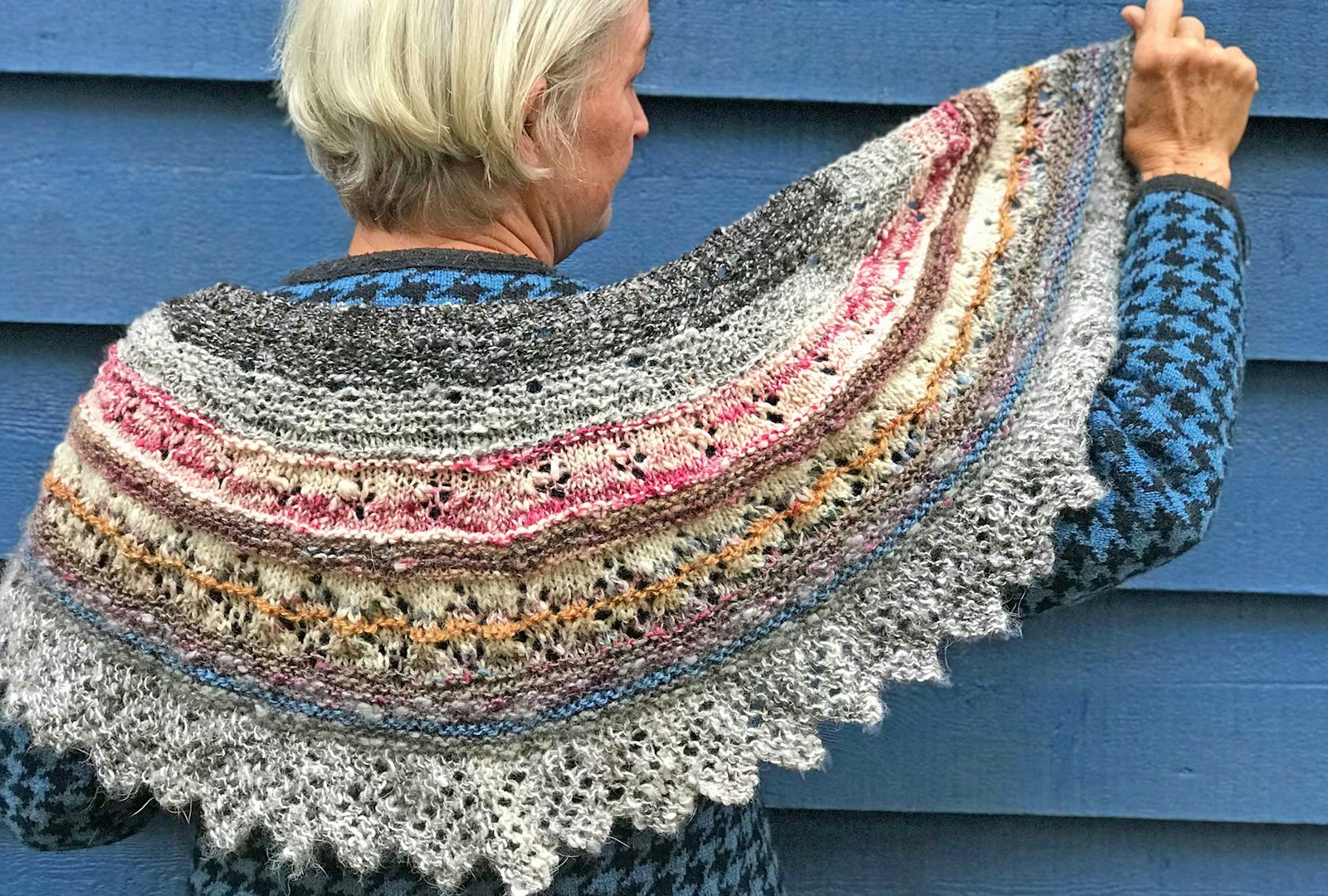
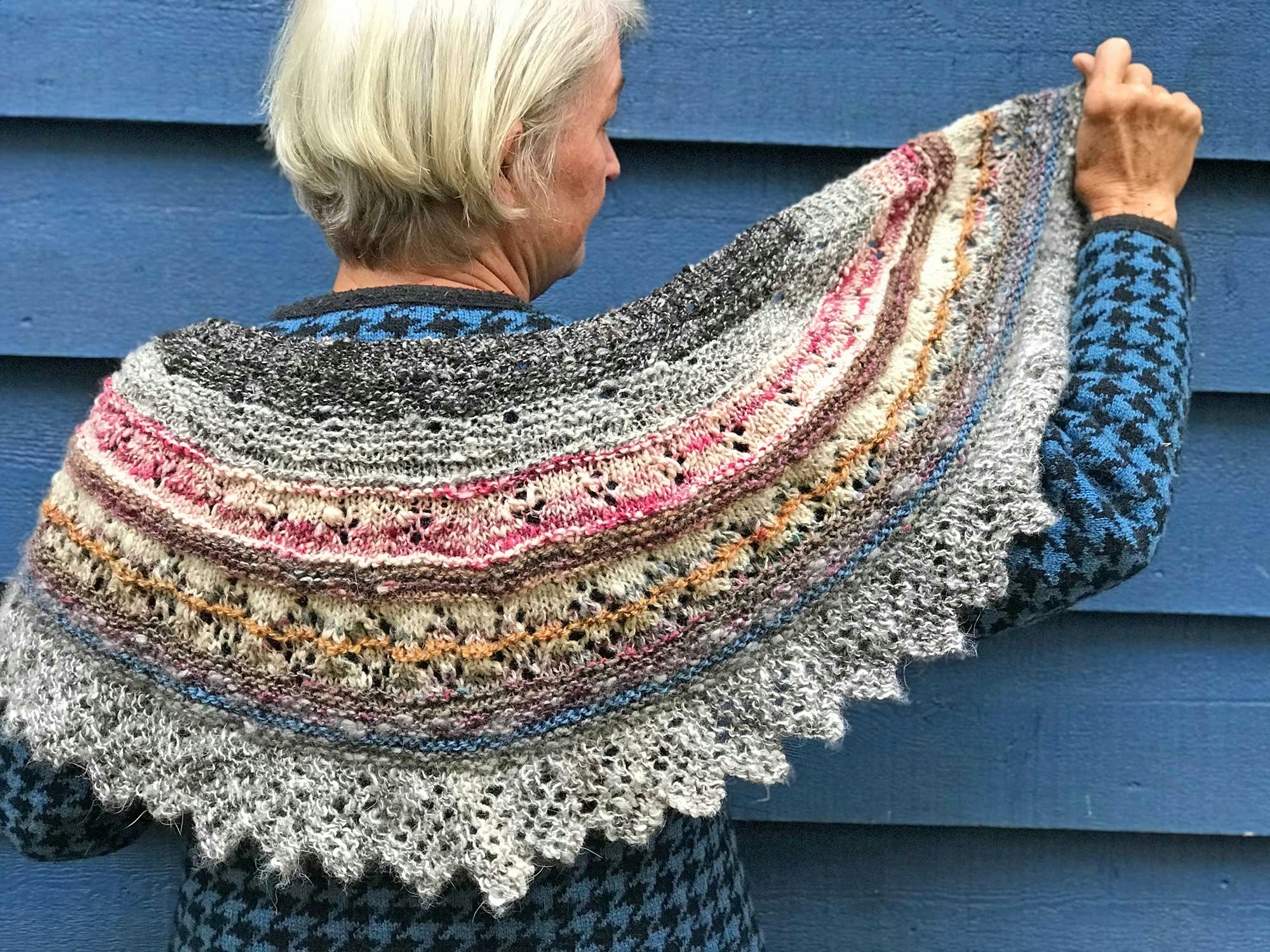
Editor‘s Note: Part pattern and part creative recipe, Martha Owen‘s Crescent Shawl invites knitters to experiment while creating a beautifully shaped, wearable wrap. With simple techniques and adaptable construction, it‘s a design you'll want to knit—and reinvent—again and again. As a longtime resident artist at John C. Campbell Folk School in North Carolina, Martha encourages students to work intuitively and be inspired by beautiful, natural materials. Grab your needles, a glass of iced tea, and get ready to cast on!
Here‘s Martha:
Follow along as I show you how to create an uncharted shape from your own imagination of colorful comfort. Sample this recipe; it‘s one to be tried, tested, and remade until it is just right! When you get started, tell yourself, “This is the first in a series—I‘ve got this! Martha is going to help!”
Materials
YARN 2–8 oz depending on size; use cobweb, fingering, or sportweight.
NEEDLES Bigger than what you would use for stockinette fabric on your yarn; we want a netting look; 2 straight, and one 24"–36" circular of matching size.
NOTIONS Markers; tapestry needle.
Special Stitches
YO Selvedge At the start of a row, put the needle under the working yarn before knitting the first stitch. This creates a YO at the beginning of the row—inc 1 st.[PAYWALL]
Start with the Edging
Ahem! Here we go! Try this unusual uncomplicated edging:
CO 3 sts, turn.
Edging row 1 Knit.
Edging row 2 Yo, k to end—1 st inc'd.
Rep rows 1 and 2 until you have 10 sts on the needle.
BO 7, k2—3 sts rem.
Yo, k3.
Repeat from Edging row 1. Continue until you have 19 wedges, about 2½ yd long. BO 9 (all sts), do not break yarn.
The important feature of edging is the YO edge loop (see Special Stitches).
 Use the circular needle to pick up stitches along the edge of the wedges.
Start Body
The edging has a big loop on one side and a point that forms when you bind off part of a row. Turn so that the straight/loopy edge faces up. This loop gives us a place for picking up stitches and provides the correct proportions for the main body of the shawl.
Using your long circular needle, pick up and knit into the loops along the straight edge of the border. Stay in garter (knitting every row), or you can add a stitch motif for a few inches: change to a textured stitch, change colors, or try a simple openwork repeat such as k5, *k2tog, yo, k5, repeat from * across, k5. Work the pattern of your choice for a few inches.
Choose the public side and mark your shawl with a locking stitch marker or scrap yarn. This is the side of your “doing something” rows. Continue knitting until 6"–7" from picked-up stitches. Count and write down the total number of stitches. An even number is handy.
 Measure from where stitches were picked up for the body.
Set-up for Shaping
K5, clip/tie a marker around the needle, add another at the center, and then mark a gusset area. Place markers 10 stitches before the center and another 10 after the center, and lastly, place a marker 5 stitches before the end.
Begin Shaping
Dec row (RS, the “do something” row) K5, slip marker (sl m), k2tog, work to 2 sts before gusset m, k2tog, sl m, work to center, sl m, work to second gusset m, sl m, k2tog, work to 2 sts before marker, k2tog, sl m, k to end—4 sts dec’d.
Next Row (WS) Knit to end. As you go along, think this: “Okay, 4 decreases per row and knit back. Got it.” After alternating these rows a few times, move the decreases geographically. For the next dec rows, k2tog somewhere after the first k5 and somewhere before the first gusset marker, not exactly where you did it last time, and again, near the other 2 decreases (not inside the center gusset area yet)—4 sts dec‘d. Continue to work WS rows even.
There are other secrets to be unveiled to get the crescent shape. The gusset/middle section will be a trapezoid, meaning, smaller at the neck and wider at the bottom.
 More shaping.
Gusset Shaping
At 9" from the picked-up sts, do your first gusset decrease. On RS rows, work 2 additional dec in the center section, once on either side of the center marker—6 sts dec‘d.
Add Dramatic Wing Decreases to Gusset Decrease
At 10", include these: k5, sl m, k2tog, *k3, k2tog, rep from * to the first gusset marker, do two extra gusset decreases, on either side of very center, sl m, *k3, k2tog, k3, k2 tog, etc. until 7 sts rem, k2tog, sl m, k5. NOTE: Work a mirror image idea on this row. Note how many extras there are before the first gusset marker and knit the same number after the second gusset marker and then begin the k3, k2tog again. Make things fit.
Continue your rhythm, doing 4 dec per RS row.
Add Second Dramatic Wing Decreases to Gusset Decrease
At 11" begin drama again: *k2, k2tog, rep from * as best as you can fit in, plus 2 extra gusset decreases near the center.
At 12" work 2 more gusset dec. This is the unique shaping which is hard to fathom until you have tried it. Since we moved the location of the decreases, we get a rounded crescent shape.
Top Edge
The body is now finished, but the top edging continues using short rows.
Set-up
K5, remove m, k1 (from the body of the shawl), turn. K2tog, k4, turn. *K6, turn. K2tog, k4, turn.*
Rep the short rows from * until you see the other edging marker. Remove m and STOP knitting.
Slip the 5 sts from the body of the shawl onto a double pointed needle. Do the same with the 5 edging sts. Break yarn leaving a 10" tail. The tail will be attached on the outside/right side of the shawl edging. Graft stitches. (If you are new to grafting in garter, here is a helpful video.)
 Working the garter edging of the shawl.
Finishing
Sew in ends, wash gently, and pin out while still damp. Leave until dry. This finishing step is what makes a shawl look like a shawl and not a wadded-up hankie. If you knit with wool, the shawl will maintain its pinned-out shape when dry. Pin it out every time you wash it, and when you do, you can make adjustments to the shape each time—another wooly gift! Put on your shawl and smile.
For me—with my own handspun, needles, and ideas—the flow very often takes over and I don’t really, really remember exactly what I did!
Try to understand that your dramatic decreases and gusset decreases are adaptable to each length of shawl you create. Your edging and length are variable, so to get the trapezoid and crescent wing shaping we do in our recipe, you might need to adjust the number of decreases and the number of rows that occur between them. You made a change that didn't come out right? Okay, start again, but if possible, don‘t rip out the previous attempt right away. This will guide your next shawl, and you can re-use the yarn later.
The idea and backstory for my pieces starts with adventure; following knitwear to lonesome places, being inspired by cultural examples of spinning for knitting, and learning about people who need sheep for daily survival. I started refining this crescent shawl shape by making a traditional Faroese/Icelandic shawl with a Shetland shawl twist. Traditional construction uses garter stitch and does not have a sculpted surface. There are 4 regular decreases per row when it starts decreasing. There are also other dramatic decreases that give it a “winged” shape.
The shawl sits neatly on the shoulders and functions as a head or shoulder or baby wrap. After a lot of experiments (all of which could be worn, mind you), I continue adapting the crescent. This is my idea of having fun!
—Martha
One Step Further
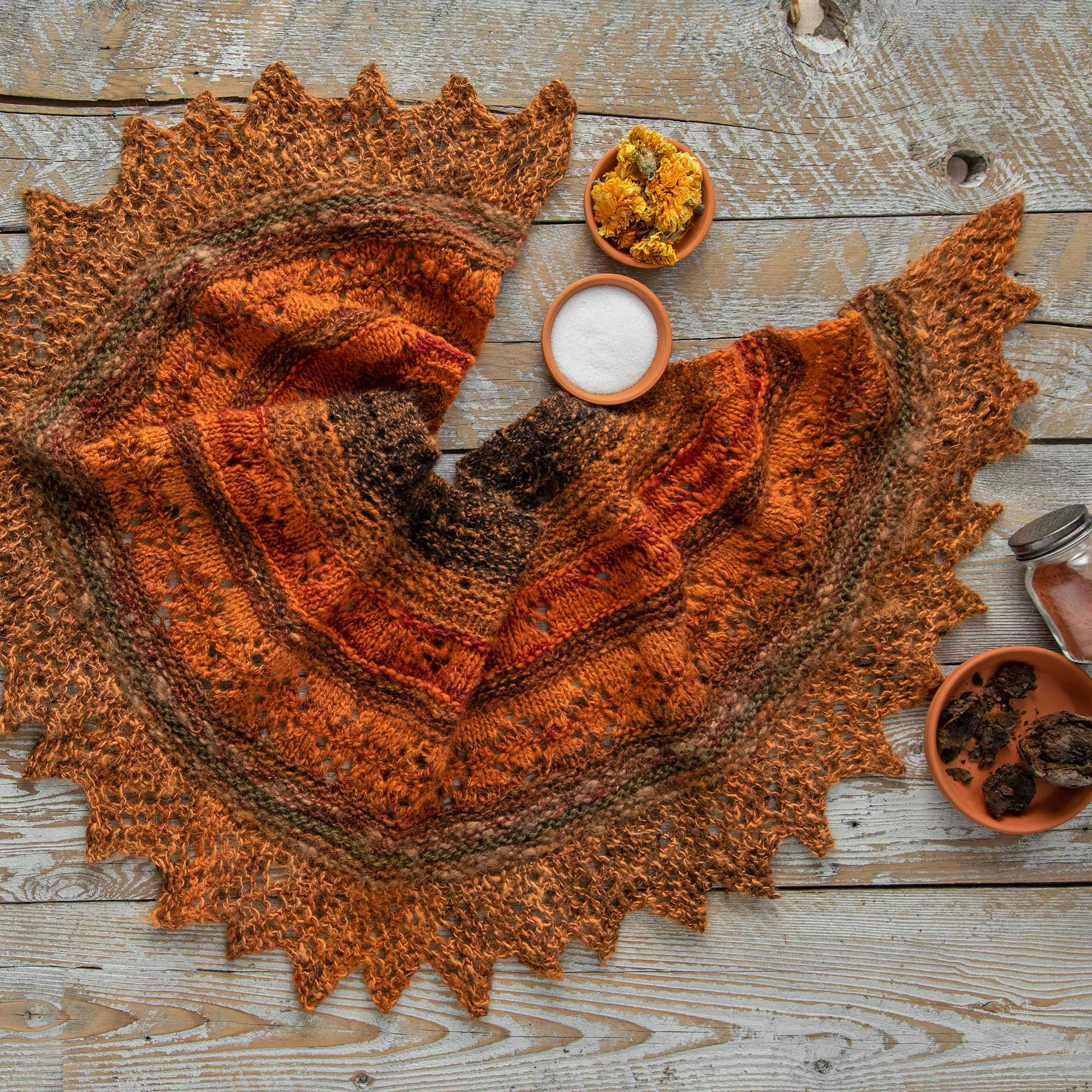
After Martha knitted her shawl using leftover odd bits of her handspun yarn, she decided to experiment by piece-dyeing it in madder and lichen. As Martha explains, “Piece dyeing is a way to refresh a garment, unify a textile created with many odd bits of yarn, or alter a palette of many shades in a previous over-dye experiment. It is also a way to recover from an ‘oops!’ color combination.”
Can this be the same shawl? Click on the images below to get a closer look at Martha's shawl before and after piece dyeing.
Read about Martha‘s color-test samples using walnut, weld and marigolds, madder, and lichen on one long swatch, allowing her to see how the same textile looked using different natural-dye methods. What follows is Martha‘s final shawl, which, after dyeing in madder and lichen, resulted in a beautifully cohesive rust-colored garment.
Subscriber Bonus!
Subscribers can access a PDF of the full article, “Piece Dyeing: It’s Never Over,” plus a PDF of the recipe for the Crescent Shawl, in the Farm & Fiber Knits Library.