
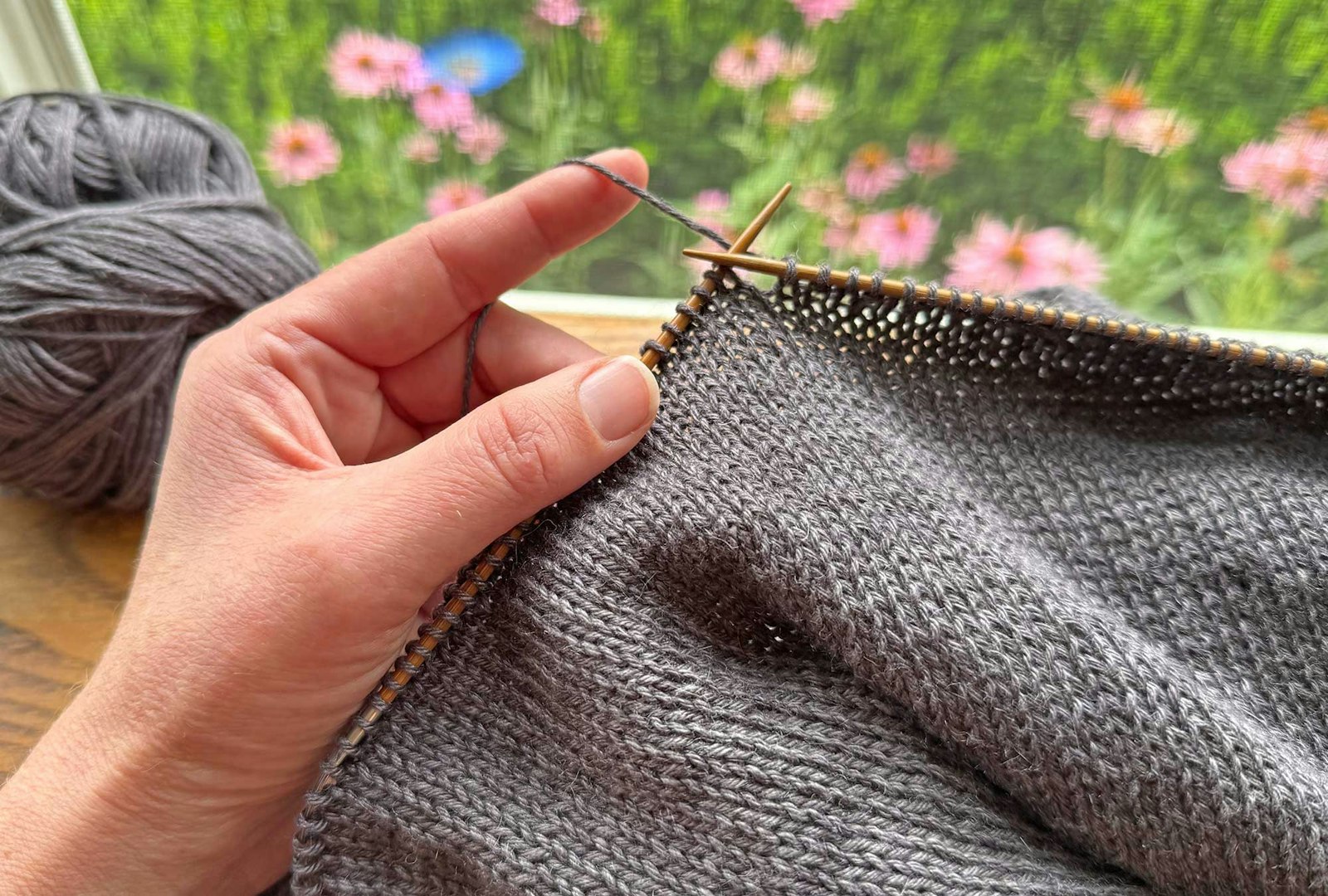
If you had asked me a decade ago if I liked knitting with linen yarns, Past Kate would have said, “Sadly, no.” Many knitters feel this way, so let me share how I learned to love knitting with linen and some tips to help you, too.
Why Linen Is So Different
Linen, hemp, and ramie are all bast fibers, meaning they are long fibers that grow in the stems of some plants. They start out as very stiff bundles of cellulose that soften with use and washing. In the not-so-distant past, high-quality linens would be passed down from one generation to the next, softening with use.
These fibers are very inelastic, so they do not give and stretch as woolen yarns do. Silk is also inelastic and can create the same tension issues and hand discomfort during knitting.
So, if you’ve tried linen or hemp yarns and found yourself unsure of the stiff fabric or with hand pain, give these tips a try.
Tips for Loving Linen Knitting Yarns
- Understand the texture will change. Understanding how the hand of the fabric will change can help you from being disappointed after the first wash. Working with these yarns (especially 100% linen or help yarns) is more like breaking in blue jeans. There was a time that you bought jeans and wore them for a while, knowing they were getting softer with each wear. It was worth the investment! These yarns will improve with every touch.
- To start: A no judgement swatch. Your typical needle sizes and preferences will likely change for linen and inelastic yarns. Just get started, grab some needles and cast on. You can always rip it out, and remember that bit about the yarn getting softer!
- Loosen up! This is a seemingly simple suggestion, but it is just about the best tip I can give you. Take a deep breath and relax your hands. Looser stitches will slide more easily.
- Try wrapping the yarn a different way. I found that tensioning the yarn in my hands as I would for wool leads to hand pain. For me, it was about not wrapping the yarn around my pinky as I normally do and just letting the yarn flow between my pinky and ring finger. See what works for you.
- Try a different needle type. I love slick metal needles for some things, but I found that they allowed me to knit linen with a tighter tension, leading to hand pain. I prefer wood or bamboo needles for inelastic yarns because the stitches will not budge if I am knitting too tightly. It helps me stay relaxed.
- Block your swatch—several times.
- Winding a skein into a ball can be tricky. If you make a center-pull ball, use the outside so the ball doesn’t collapse as it is used, creating a tangle. It’s not fun! You can also wind your yarn by hand around a leftover ball of yarn. Keep it in a bag or wrapped in a towel as you knit so the ball doesn’t unwind and tangle.
- Project monogamy. Over the years, I have found it difficult to have a project in wool yarn and a project in an inelastic yarn going at the same time. When I am knitting linen, I stick to the project to improve my tension consistency.
- Check tension between stitches on left and right needles. This really helps me! When I sit down to knit and pick up my project, I begin knitting and then check the stiches on the left and right needle. Do they have the same tension? The stitches on the left are what you knitted during the last session, so you can compare your newly made stitches on the right.
- Stop every few rows to check stitches for dropped plies. These yarns can be a bit “splitty,” and it is easy to drop a ply of the yarn here and there. Every few inches, just take a look at your work so you can fix any messy stitches sooner than later.
- Rip sooner than later. This one can be painful, but I find it is part of the process for me when working with inelastic yarns that show tension changes more readily than squishy, forgiving wools. If I’m knitting a project where it matters (like the front yoke of a sweater) t’s better to just ravel and start a section over rather than hoping it will all even out in my experience.
- Know how your fabric will stretch. The yarn is inelastic, but knitted fabric is elastic, so most people find that their knits stretch in length and pull in a bit side to side. You can get some of this information from a swatch, but if making a fitted garment, keep this in mind. If you are knitting a top-down sweater, for example, you might put the bottom hem on a holder and block before binding off to check the finished garment length.
- Again, your project might feel crispy! The more the yarn and fabric are handled, worn, and laundered, the better they will feel.
- 100% linen just not your jam? There are loads of great blends out there now, such as the linen and silk blend I’m knitting with now (top of the page). You might also look for chainette linen yarns. These yarns are knitted tubes, which have more elasticity and flexibility, and they are also lighter weight. There are natural fibers out there for all of us!